Explore all 13 supporting guides
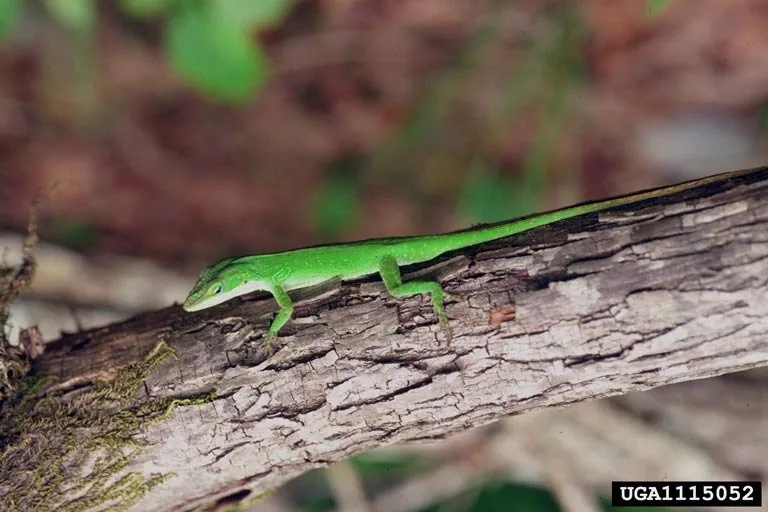
Bright green one minute and dull brown the next, the green anole (Anolis carolinensis) is a small, slender lizard native to the southeastern United States. It can shift its color within minutes. That habit earned it the misleading nickname “American chameleon.”
A green anole is not a true chameleon at all. It belongs to its own family, the Dactyloidae. Its color change tracks temperature, mood, and health rather than the background it sits on.
At a glance: Adult size 5 to 8 inches including the tail.
Lifespan runs 4 to 6 years in captivity, sometimes longer.
Diurnal, arboreal, and insectivorous, with a minimum enclosure near 18x18x24 inches for one adult.
Basking spot around 85 to 90F, humidity 50 to 70%, and a species better suited to watching than handling.
An adult weighs only 2 to 6 grams, yet this is one of the most commonly kept lizards in the United States. It is cheap to buy, widely available, and rewarding to watch. The full anole species guide shows how it compares with its larger and more colorful relatives.
Where Green Anoles Come From
The green anole is native to the southeastern United States. Its range covers Texas, Oklahoma, Arkansas, Louisiana, Mississippi, Alabama, Georgia, Florida, South Carolina, North Carolina, Tennessee, and Virginia.
It also occurs naturally in parts of the Caribbean, including the Bahamas, Grand Cayman, and Cuba. Within that range it lives in forests, woodland edges, and increasingly in suburban yards and gardens.
People have introduced green anoles to several places outside their native range, including Hawaii and parts of Japan. On some Pacific islands, introduced green anoles have harmed native insect populations.
That history is a reminder that any released pet lizard can cause real ecological damage. Releasing an unwanted pet is never a safe option, for the local wildlife or for the lizard itself.
Within its native range, the green anole faces a newer challenge of its own. The brown anole, introduced from Cuba and the Bahamas, has spread through much of the Gulf Coast.
This newcomer has pushed green anoles higher into trees in many areas. Researchers have documented rapid changes in green anole toe pads in response to this competition.
That kind of fast, observable adaptation is part of why the species has become a well studied model organism. It sits alongside its long running role as one of the most common pet lizards in the United States.
Green Anole Care Overview
Green anole care comes down to three things. Vertical space, steady warmth with a real day and night swing, and consistent humidity.
This species is arboreal. It spends most of its life climbing rather than walking across open ground.
A tall, planted enclosure with branches and foliage suits a green anole far better than a wide, bare tank, and the housing guide covers the options. Keepers commonly report that anoles kept in cramped or sparsely decorated setups grow stressed.
Stressed anoles often stop eating and stay dark colored for long stretches. Good ventilation matters just as much as humidity.
A screen top or mesh enclosure lets fresh air circulate. Daily misting then keeps the air from drying out between waterings, without letting the enclosure turn stagnant.
Enclosure Setup
A single adult green anole needs at least an 18x18x24 inch enclosure. The extra height should go toward climbing room rather than floor space, since this lizard rarely uses the ground.
A small group works differently. Keeping one male with one or two females does better in something closer to 18x18x36 inches, since more floor and branch space reduces territorial stress between the females.
Live or artificial plants should fill most of the vertical area. Cork bark and branches give the anole places to perch, bask, and retreat.
Anoles like to sit just below the basking light. When they feel exposed, they duck into the foliage.
| Enclosure feature | Recommendation |
|---|---|
| Minimum size, one adult | 18x18x24 in, tall, with a screen or mesh top |
| Substrate | Coconut fiber or an organic soil mix that holds some moisture |
| Climbing structure | Branches, cork rounds, and dense live or silk plants |
| Water source | A shallow dish plus daily misting, since anoles often drink droplets off leaves |
A drainage layer under the substrate, or a false bottom, helps stop standing water from pooling after misting. Overly wet substrate encourages mold and mites.
Daily spot cleaning of waste and uneaten feeders keeps the enclosure healthy. A dry side and a slightly damper side inside one enclosure gives the anole a choice.
Heating and Lighting
Green anoles need a basking spot around 85 to 90F. The cooler end of the enclosure should sit closer to 75 to 80F.
This gradient lets the lizard move between zones and pick its own temperature. A nighttime drop into the high 60s or low 70s is normal.
This species experiences seasonal and nightly temperature swings across much of its wild range. A stable, unchanging temperature is not required, and may even feel unnatural to the animal.
Full spectrum UVB lighting is considered standard practice for this species. UVB supports the anole’s own vitamin D3 production, which it needs to process dietary calcium.
Without adequate UVB, plus calcium and D3 supplementation, green anoles face a real risk of metabolic bone disease. This is one of the most common preventable problems in small captive lizards.
A basking bulb paired with a linear UVB tube spanning most of the enclosure length works well, and our gear recommendations cover fixtures in more detail. It lets the anole choose how much exposure it wants, rather than forcing constant direct light.
Bulbs lose UVB output over time even while still producing visible light. Replacing UVB tubes roughly every six to twelve months keeps the output where it needs to be, following the manufacturer’s guidance for that specific bulb.
What Green Anoles Eat
In the wild, green anoles eat a wide range of small invertebrates. Flies, beetles, moths, and spiders make up much of the diet, caught mostly by ambush from a perch.
In captivity, the diet centers on appropriately sized crickets. Fruit flies suit juveniles well.
Small dubia roach nymphs work as a staple or an occasional swap for variety. Rotating between a couple of feeder types tends to keep adult anoles interested at feeding time.
Feeder insects should be no larger than the space between the anole’s eyes. Oversized prey can be difficult to swallow and offers little nutritional benefit beyond a properly sized feeder.
Gut loading feeders with fresh produce before offering them improves their nutritional value. Dusting feeders with a calcium powder at most feedings covers much of the gap left by a pure insect diet.
A vitamin D3 and multivitamin powder used less often rounds out the supplement routine. Together, gut loading and dusting do more for long term health than any single feeder choice. The feeding guide explains both routines step by step.
Juveniles typically eat daily, since they are growing quickly. Adults usually do well with feeding every one to two days instead.
Offer only what the anole will finish within a few minutes. Leftover insects wandering the enclosure overnight can stress the lizard and, in some cases, bite it while it sleeps.
Health and Common Problems
Metabolic bone disease is the most common preventable health issue in small insectivorous lizards. It stems from insufficient UVB, calcium, or vitamin D3 over time.
Warning signs include a soft or swollen jaw and general weakness. A green anole with the condition may also struggle to climb branches it once handled easily.
Dehydration is another frequent problem, especially in low humidity setups. Sunken eyes, loose or wrinkled skin, and a drop in appetite are early signs worth acting on.
Green anoles readily drop their tails if grabbed or startled. This defense is called autotomy, and it is a normal, survivable event rather than an emergency.
The regrown tail is usually shorter and less colorful than the original. It regrows as cartilage rather than true vertebrae, which is why it often looks and moves a little differently.
Respiratory infections can develop in enclosures that stay too cool or too damp without adequate airflow. Watch for open mouth breathing, wheezing, or discharge around the nose and mouth.
The health hub outlines warning signs shared by many small lizards. A reptile veterinarian experienced with small lizards is worth locating before problems appear. Anoles can decline quickly once they stop eating, so early attention matters more than with larger, hardier species.
Behavior and Temperament
Green anoles are diurnal, active, and strongly territorial. Males extend a pink dewlap and bob their heads to warn off rivals or attract females.
This display is easy to watch through the glass and often the most engaging part of keeping the species. Because of this territoriality, housing two males together almost always ends in fighting.
Even brief encounters between males can cause real injury. A single enclosure should never hold more than one adult male.
A single male can often live with one or more females in a large enough enclosure. Even then, close observation still matters, watching for bullying or one animal being denied access to food and basking spots.
This species tolerates minimal handling at best. Frequent handling tends to cause stress, darker coloration, and reduced feeding.
Green anoles generally suit keepers who enjoy watching natural behavior rather than interacting directly. A well set enclosure rewards patient observation with visible territorial displays, hunting, and basking behavior.
Breeding
In the wild, green anoles breed roughly from April through August. Females lay one or two eggs at a time, repeating every couple of weeks through the season.
Incubation runs roughly five to seven weeks, depending on temperature. Warmer conditions generally shorten that window, while cooler conditions stretch it out.
Captive breeding largely follows the same pattern. Letting photoperiod and temperature cycle naturally through the seasons helps trigger normal reproductive behavior, rather than holding everything constant year round.
Eggs are typically left undisturbed in moist substrate. Some keepers instead move them carefully to a shallow container of moist vermiculite or coco fiber.
Room temperature incubation is usually sufficient for this species. Extra heat is rarely needed as long as the room stays reasonably warm through the incubation period.
Hatchlings emerge looking like miniature adults, fully capable of hunting small prey. They should be raised separately from adults, since larger anoles will readily eat small insects, and sometimes hatchlings themselves.
Lifespan and Size
Adult green anoles reach about 5 to 8 inches in total length. More than half of that length is tail, with the body itself staying quite small and slender.
Males run larger than females and develop a more prominent dewlap and slightly longer head. Adult weight typically falls in a very light range, just a few grams. The knight anole and the Cuban false chameleon, both relatives, dwarf it.
In the wild, most green anoles live two to eight years. Sources differ on the upper end.
Predation pressure and habitat quality vary a great deal across the species’ large range. That variation makes a single, precise wild lifespan figure hard to pin down.
In captivity with steady care, four to six years is typical. Some individuals are reported to live longer under especially consistent conditions, though there is no single confirmed maximum record.
Cost of Keeping a Green Anole
The green anole itself is one of the least expensive lizards in the pet trade. Prices commonly fall in the ten to twenty five dollar range, depending on the seller and region.
The real cost sits in the setup rather than the animal. A properly sized, planted, heated, and UVB lit enclosure for a single anole commonly runs a few hundred dollars.
That figure covers lighting, substrate, and decor once everything is factored in. Building the setup well from the start usually costs less than replacing cheap gear twice.
Ongoing costs stay fairly modest after setup. They mostly cover feeder insects, supplement powders, and occasional bulb replacement every six to twelve months. Anyone still deciding on a first lizard may want to read choosing a pet lizard before settling on a green anole.
Frequently Asked Questions
Is a green anole a good pet for beginners?
Yes, in terms of cost and basic husbandry, a green anole is often recommended as an entry level lizard. It is not a handling pet, so it suits someone who wants to observe natural behavior rather than interact directly.
Do green anoles need a heat lamp at night?
Most green anoles do not need supplemental heat overnight as long as room temperature stays above the mid 60s F. A natural night drop is normal for this species, mirroring its wild conditions.
Can green anoles live together?
Two males will almost always fight and should never share an enclosure. A single male can sometimes live with one or more females in a large, well planted enclosure with careful monitoring.
Why does my green anole turn brown?
Color shifts between green and brown are driven by temperature, stress, health, and activity level, not primarily camouflage. A green anole that stays dark brown for days is worth checking closely, especially alongside reduced appetite.
What is the difference between a green anole and a brown anole?
The green anole is native to the southeastern United States and can turn green or brown. The brown anole is an introduced species from Cuba and the Bahamas that stays brown with a ridged back.
The brown anole has expanded through much of the green anole’s range over the past several decades. In many areas the two species now compete directly for perches and territory.
How often should I mist a green anole enclosure?
Most keepers mist once or twice daily to keep humidity in the 50 to 70% range. This also gives the anole water droplets to drink off leaves.
A hygrometer placed inside the enclosure takes the guesswork out of monitoring humidity. Checking it daily makes it easy to catch a setup that is running too dry.
Sources
- The Reptile Database: Anolis carolinensis species account. https://reptile-database.reptarium.cz/species?genus=Anolis&species=carolinensis
- Animal Diversity Web, University of Michigan: Anolis carolinensis. https://animaldiversity.org/accounts/Anolis_carolinensis/
- IUCN Global Invasive Species Database: Anolis carolinensis profile. https://www.iucngisd.org/gisd/species.php?sc=604
- Savannah River Ecology Laboratory, University of Georgia: Green Anole species page. https://srelherp.uga.edu/lizards/green-anole/