At a glance: The best heat lamp for chameleons is a low wattage incandescent bulb on a dimming thermostat above a screen enclosure. Our top pick is the Zoo Med Repti Basking Spot Lamp. Match the bulb to your species: basking targets run from about 82 to 110 degrees Fahrenheit.
As an Amazon Associate, Lizardist earns from qualifying purchases. Some product links on this page are affiliate links.
- Best overallZoo Med Repti Basking Spot LampView on Amazon
- Best for open top setupsZoo Med Repti Lamp StandView on Amazon
- Best thermostat pairingVivarium Electronics VE-100 Dimming ThermostatView on Amazon
The best heat lamp for chameleons is a low wattage incandescent or halogen basking bulb. It is not a heavy duty bulb built for a bearded dragon or a monitor. Chameleons bask in short stretches, then retreat to shade.
The bulb only needs to warm one small perch. A dimming thermostat keeps that perch from overheating on a warm afternoon. Most chameleon enclosures use screen or mesh sides, so wattage needs stay lower than for many other pet lizards.
Screen loses heat fast. The goal is a warm perch near the bulb, not a warm room. The right chameleon heat bulb depends heavily on species, so check the table below first.
What to Look for in a Chameleon Basking Bulb
Picking the best heat lamp for chameleons starts with matching wattage to species, not with the biggest bulb on the shelf. Basking needs vary sharply from one species to the next.
Veiled chameleons and panther chameleons come from warm lowland habitat. They want a genuinely hot perch. Sources differ on how hot for a veiled: the ARAV chameleon proceedings give a 95 to 110 degree basking site, while LafeberVet lists a gradient of 70 to 95 degrees, so treat 95 as the safe target and only go higher for a large adult that keeps seeking more heat.
Jackson’s chameleons and other montane species evolved in far cooler mountain air. LafeberVet gives them a basking spot of only 82 to 85 degrees Fahrenheit and warns against holding them above 84 degrees for long. In a warm room the lowest wattage bulb sold may still be too much.
Buying a bulb before you confirm your species’ target range is a common mistake. A bulb sized for a veiled chameleon can overheat a montane species in the same room. A bulb sized for a cool species will leave a veiled or panther chameleon underheated.
| Species | Basking spot | Daytime ambient | Nighttime |
|---|---|---|---|
| Veiled chameleon | 95 to 110 degrees F (ARAV); LafeberVet tops its gradient at 95 | 80 to 88 degrees F | 65 to 75 degrees F, at least a 10 degree F drop from daytime |
| Panther chameleon | About 95 degrees F | 70 to 90 degrees F | 65 to 70 degrees F |
| Jackson’s chameleon | 82 to 85 degrees F, lowest wattage bulb | 70 to 80 degrees F, never above 84 for long | 55 degrees F to the mid 70s |
Check your exact species against a dedicated chameleon care guide before buying wattage. A montane species run at lowland temperatures can overheat within a single afternoon.
Bulb type matters almost as much as wattage. A plain incandescent basking spot bulb covers most veiled and panther chameleon setups. Halogen basking bulbs run hotter for the same wattage.
Halogen also holds its output more steadily. That helps in a cool room or a large mesh enclosure, where heat escapes fast.
Skip a ceramic heat emitter as the sole basking source. Chameleons are daytime baskers that move toward a lit, warm perch, and a dark heater gives no such target. A ceramic heat emitter still earns a place holding nighttime temperature in a cold room, alongside a daytime basking bulb.
A reptile heat mat is not a fit for chameleons at all. Chameleons are arboreal. They bask up in the branches, never on the enclosure floor.
Floor heat does nothing for the animal. It can also scorch a chameleon that is dropped or misplaced onto one.
Start wattage low and adjust from a thermometer reading, not from the number on the box. Begin with the lowest wattage sold for the bulb and read the perch with a probe after 20 minutes. Step up one wattage at a time only if the perch reads under target.
Pair the basking bulb with a UVB fixture chosen from our chameleon UVB light guide. Basking heat and UVB serve different jobs, and neither one replaces the other.
Our Picks

Zoo Med Repti Basking Spot Lamp
Best for veiled and panther chameleons in most screen enclosures
- Incandescent basking spot bulb
- Sold in a range of wattages
- Pair with a dimming thermostat, not an on and off unit
Why we pick it
- Low wattage options match the modest basking needs of most pet chameleon species
- A wide wattage range covers small screen cages and larger mesh enclosures alike
- Widely stocked, so a replacement bulb is easy to find
Keep in mind
- Still needs a dimming thermostat and a fixture rated above its wattage
- Confirm the actual perch temperature since screen sides pull heat away fast

Zoo Med Repti Halogen Basking Spot Lamp
Best for larger panther chameleon enclosures or rooms that run cool
- Halogen flood bulb
- Holds output more steadily than a plain incandescent bulb
- Runs hotter per watt, so start lower than an incandescent equivalent
Why we pick it
- Steadier heat output through a fluctuating room temperature
- A concentrated flood beam suits a single high perch
- Useful in large mesh enclosures where a plain incandescent bulb cannot reach target
Keep in mind
- Easy to overshoot a basking target in a small cage, always pair with a dimming thermostat
- Skip it for most veiled and panther setups already hitting target on a plain incandescent bulb

Zoo Med Repti Lamp Stand
Best for screen cages without a solid canopy to clamp onto
- Freestanding stand rated for heat fixtures
- Adjustable height for fine tuning basking distance
- Keeps the fixture off the mesh itself
Why we pick it
- Most chameleon cages are mesh with no solid top to mount a clamp lamp onto directly
- A stand lets the bulb sit above open mesh without resting on it
- Adjustable height helps dial in target temperature without changing bulb wattage
Keep in mind
- Confirm the weight rating before hanging a heavier ceramic fixture
- Needs floor or shelf space beside the enclosure
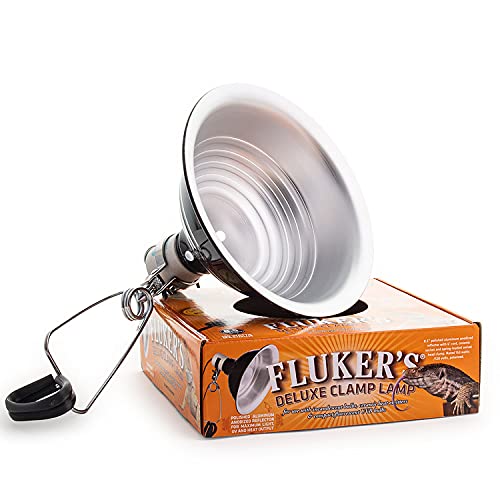
Fluker’s Ceramic Clamp Lamp
Best for a basking bulb that runs warm, or for pairing with a nighttime heat source
- Ceramic socket handles higher heat without melting
- Clamp mount for a solid canopy or a stand
- Rated for basking bulbs and ceramic heat emitters alike
Why we pick it
- A ceramic socket tolerates more heat than plastic, useful if a ceramic heat emitter also runs at night
- A solid clamp holds steady over one perch
- One fixture serves the day bulb and a night heat source
Keep in mind
- Clamping directly onto mesh can still burn the screen, mount it on a stand or solid canopy instead
- Costs more than a basic plastic socket dome

Zoo Med Repti Clamp Lamp
Best for a straightforward incandescent basking bulb setup
- Plastic dome fixture rated for basking bulbs, not for UVB
- Adjustable clamp mount
- Lower cost than a ceramic socket dome
Why we pick it
- Affordable when running only a plain incandescent basking bulb
- A simple clamp mount attaches to a solid canopy edge
- Widely available for quick replacement
Keep in mind
- Not rated for high wattage ceramic heat emitters
- Keep it off the screen top itself, where it can overheat or melt the mesh

Vivarium Electronics VE-100 Dimming Thermostat
Best for any basking bulb or ceramic heater on a chameleon enclosure
- Dimming type, holds temperature steadier than an on and off unit
- Rated for basking bulbs, halogen floods, and ceramic heaters
- Higher cost than a basic on and off thermostat
Why we pick it
- Dimming control avoids the swings an on and off thermostat allows near delicate screen and skin
- Works with a daytime basking bulb and a nighttime ceramic heater in the same setup
- Accurate probe placement at the perch keeps the reading meaningful
Keep in mind
- Must be sized to the bulb’s wattage, check the rating before buying
- Costs more than a simple on and off thermostat
| Product | Type | Best for | |
|---|---|---|---|
| Zoo Med Repti Basking Spot Lamp | Incandescent basking bulb | Most veiled and panther chameleon setups | View |
| Zoo Med Repti Halogen Basking Spot Lamp | Halogen basking flood bulb | Cool rooms or large mesh enclosures | View |
| Zoo Med Repti Lamp Stand | Lamp stand | Screen cages with no solid canopy | View |
| Fluker’s Ceramic Clamp Lamp | Clamp lamp, dome fixture | Warm running bulbs or a paired night heater | View |
| Zoo Med Repti Clamp Lamp | Clamp lamp, dome fixture | Basic incandescent bulb setups | View |
| Vivarium Electronics VE-100 Dimming Thermostat | Dimming thermostat | Any basking bulb or ceramic heater | View |
Setting Up and Using a Chameleon Heat Lamp
Mount the fixture above the enclosure. Do not rest it against the screen. A lamp stand works well on a mesh cage with no solid top.
A clamp lamp needs a solid canopy edge or a rim it can grip without touching the mesh. Leave an air gap between the bulb and the screen, generally several inches.
Merck advises placing heat sources more than 18 inches above the floor covering and running every heat source on a thermostat. It also warns that overheating under heat lamps is common, and that running only 10 degrees above a species’ upper limit may prove deadly.
Merck also calls for at least two thermometers, one at the warm end and one at the cool end. A single reading under the bulb tells you nothing about the gradient the chameleon can choose from.
Confirm the gap with your hand held near the mesh after the bulb has run for twenty minutes. Warm mesh close to a perch can burn skin and eyes on contact. A chameleon often climbs right up to the warmest point in its cage.
Place the thermostat probe at the basking perch itself. Use the same height and distance the chameleon actually reaches. A probe near the floor will let the perch run far hotter than the display suggests.
Run the basking bulb on a light timer matched to a normal day length. Merck gives tropical species about 10 hours of daylight in winter and 14 in summer, so 12 hours is a sound year round middle. Turn the bulb off completely at night.
Every species in the table above needs a real nighttime drop. A bulb left on overnight removes that drop entirely. It also removes the animal’s chance to cool down.
Pair the basking bulb with a fixture rated for its wattage. Chameleon cages sit closer to household humidity swings than a typical desert setup. Check the fixture and bulb for cracks or discoloration every few months.
Replace either one at the first sign of damage. Watch the animal, not just the thermometer. A chameleon pressed into the coolest corner all day is signaling that the basking spot runs too hot.
Common Mistakes
These setup mistakes come up again and again. Most are easy to avoid once you know to look for them.
- Buying a bulb sized for a bearded dragon or uromastyx, then using it on a chameleon without checking the species’ basking range
- Clamping a dome fixture directly onto screen mesh, where it can scorch the mesh or melt a plastic socket
- Running a basking bulb through the night instead of giving the animal its normal temperature drop
- Skipping a thermostat because the bulb is low wattage, when even a small bulb can spike a cage on a warm day
- Placing a heat mat under the enclosure, which does nothing for an arboreal species that never touches the floor
- Assuming every chameleon species wants the same basking temperature as a veiled or panther chameleon
Frequently Asked Questions
What wattage heat lamp does a chameleon need?
There is no single wattage, because screen cages lose heat fast and room temperature varies. Start with the lowest wattage sold for the bulb and measure the perch with a probe thermometer. Step up one size at a time only if the perch reads below target.
Do chameleons need a heat lamp at night?
No. Every species needs a nighttime temperature drop. In a room that falls below the mid 60s F, a separate ceramic heat emitter on its own thermostat can hold ambient temperature without adding light.
Can I use a ceramic heat emitter instead of a basking bulb?
Not as the only heat source. Chameleons are daytime baskers that seek a lit, warm perch, and the ARAV proceedings list incandescent bulbs in reflector clamp lamps as the standard daytime heat source. A ceramic heat emitter fits better as a nighttime backup in a cold room.
How close should a heat lamp sit to a chameleon’s perch?
Close enough to hit the species’ basking target, and no closer. The fixture should never touch the screen. Check the manufacturer’s minimum clearance, then confirm the actual perch temperature with a thermometer.
Do all chameleon species need the same basking temperature?
No. Veiled and panther chameleons want a hot perch of 95 degrees F or more. Montane species such as Jackson’s chameleon need only a mild 82 to 85 degree spot, and should never sit above 84 degrees for long.
Is a screen or mesh cage safe to use with a heat lamp?
Yes, as long as the fixture sits on a stand or a solid canopy edge rather than the mesh. Pair the bulb with a dimming thermostat. Direct contact between a hot fixture and screen mesh is the most common cause of melted or scorched cages.
Sources
- LafeberVet: Basic Information Sheet, Panther Chameleon. https://lafeber.com/vet/basic-information-for-the-panther-chameleon/
- Association of Reptilian and Amphibian Veterinarians, Proceedings: Captive Management, Breeding, and Common Diseases of Chameleons. https://cdn.ymaws.com/members.arav.org/resource/resmgr/Files/Proceedings_1997/1997_07.pdf
- Animal Diversity Web: Chamaeleonidae. https://animaldiversity.org/accounts/Chamaeleonidae/
- San Diego Zoo Wildlife Alliance: Chameleon. https://animals.sandiegozoo.org/animals/chameleon
- LafeberVet: Basic Information Sheet, Jackson’s or Three Horned Chameleon. https://lafeber.com/vet/basic-information-for-jacksons-or-three-horned-chameleon/
- LafeberVet: Basic Information Sheet, Veiled Chameleon. https://lafeber.com/vet/basic-information-for-veiled-chameleon/
- Merck Veterinary Manual: Providing a Home for a Reptile. https://www.merckvetmanual.com/all-other-pets/reptiles/providing-a-home-for-a-reptile