At a glance: A crested gecko enclosure should be tall rather than wide. A single adult needs a vertical terrarium of at least 18 by 18 by 24 inches, with screen panels for airflow and several branches. Hatchlings start much smaller, in cups or 8 to 10 inch cubes, then move up in stages.
As an Amazon Associate, Lizardist earns from qualifying purchases. Some product links on this page are affiliate links.
A crested gecko enclosure is built around one fact of biology. Correlophus ciliatus is arboreal. It spends nearly all of its active time climbing branches, leaves and glass, not walking on a floor.
Veterinary care sheets agree on the adult minimum. One exotics practice lists an 18 by 18 by 24 inch terrarium, or 20 to 30 gallons, for an adult. Another sets the floor at 18 by 18 by 18 inches and at least 20 gallons.
That single trait decides tank shape, branch placement and even substrate choice. This guide covers the enclosure only, not temperature or humidity numbers.
For those, see the linked heating and lighting guide and humidity guide. For feeding and day to day upkeep, see the main crested gecko care guide.
Why the Enclosure Should Be Tall, Not Wide
Wild crested geckos live in the rainforest of New Caledonia. Animal Diversity Web describes them resting by day in thick vegetation near the forest floor, then foraging at night, rarely more than about 3 meters up. The Reptile Database notes that their climbing and jumping mechanics have drawn specific scientific study.
This species handles narrow branch travel unusually well. Toe pads, claws and other climbing anatomy are built for gripping vertical and overhead surfaces.
A floor plan terrarium made for a ground dwelling lizard wastes most of its space here. The gecko rarely touches the substrate. It only comes down to eat, drink or lay eggs.
Height above floor area is the priority. An 18 by 18 inch footprint that stands 24 inches tall gives an adult more climbing surface. A 20 gallon tank on its side looks bigger but offers less.
Terrariums built for arboreal species are sold in these taller proportions for that reason.
Crested Gecko Enclosure Size by Age
Crested gecko tank size should scale with the animal. A hatchling placed straight into a large open enclosure can struggle to find food. It can also go unnoticed for days if it stops eating or gets sick.
Smaller starter housing is standard veterinary and breeder advice. One exotics veterinarian keeps juveniles under 12 grams in a 5 gallon terrarium of about 8 by 8 by 12 inches. Another clinic sheet puts babies in 5 to 10 gallon enclosures before the adult tank.
| Life stage | Approximate age | Recommended enclosure size |
|---|---|---|
| Hatchling | 0 to 3 months, under 12 grams | Ventilated cup or a 5 gallon terrarium of about 8 by 8 by 12 inches, paper towel floor, minimal decor |
| Juvenile | 3 to 9 months | 5 to 10 gallons, for example 12 by 12 by 18 inches |
| Subadult | 9 to 18 months | 16 by 16 by 20 inches, or straight to adult size |
| Adult | 18 months and older | 18 by 18 by 24 inches (20 to 30 gallons); 18 by 18 by 18 inches is the lowest veterinary minimum; 18 by 18 by 36 inches is common |
The adult figures come from veterinary care sheets, not regulation. Arbor View Animal Hospital lists 18 by 18 by 24 inches or a 20 to 30 gallon terrarium. Aurora Animal Hospital sets the minimum at 18 by 18 by 18 inches and at least 20 gallons, and other exotics clinics say 20 gallons or larger for one adult.
Treat 18 by 18 by 24 inches as the working adult standard. Bigger is rarely a problem once feeding is reliable and cover is adequate.
Some keepers start a juvenile straight in an adult sized enclosure. They add extra branches near the floor and lid. That gives the young gecko shorter climbs while it grows into the space.
Vertical Terrarium for Crested Gecko: Dimensions and Layout
A vertical terrarium for crested gecko housing is described by width, depth and height, in that order. For example, 18 by 18 by 24 inches.
Height matters most. It sets how many climbing routes and temperature zones fit between the warm top and cooler bottom.
Depth of at least 18 inches lets branches run diagonally. It also gives the gecko room to turn around on a perch. A narrow but very tall enclosure can leave only one or two vertical routes.
Width and depth should not be sacrificed purely to add height. A tank that is tall but only 12 inches deep limits branch angles and hide placement. Most keepers treat 18 inches as the practical minimum on all three sides for an adult.
Glass Versus Screen and Ventilation
Two enclosure styles dominate the crested gecko terrarium market. The first is front opening glass with mesh or screen panels for airflow. The second is an all screen mesh cage.
Glass with a screen top is the more common choice. It holds humidity more evenly while still allowing airflow.
That balance suits this species. Substrate and foliage should dry out some between mistings, not stay soaked all day.
All screen enclosures lose humidity fast. They are harder to keep in range unless the room itself is warm and humid, or misting happens often.
Ventilation should never be sealed off completely, even in a glass tank. Stagnant, saturated air encourages mold and respiratory illness.
A working crested gecko cage setup balances a mostly enclosed body with enough open mesh. A full screen top plus one or two side vents is typical. That combination lets humidity fall between mistings instead of sitting at saturation all day.
Front opening doors also matter for daily handling. They let a keeper feed and mist without lifting a heavy screen lid.
A lifted lid gives an alert gecko a chance to climb out. Doors with a secure latch matter too, since crested geckos are strong, persistent climbers.
Branches, Foliage and Climbing Structure
Furnishing a crested gecko enclosure means filling vertical space with routes, not decorating a floor. Cork bark rounds and flats, manzanita or grapevine branches, and sturdy vines should crisscross the tank at several heights. Angle them so the gecko can move from floor to canopy without one long unbroken drop.
Dense foliage in the upper two thirds of the tank gives a shy, nocturnal animal a place to rest by day. Silk plants are common and easy to clean. Live plants suited to humid terrariums, such as pothos, ficus, or bromeliads, also work well.
Secure every perch so it cannot shift or collapse under the gecko’s weight. A perch that gives way can startle a gecko into dropping its tail. In this species the tail never grows back, as the Aurora Animal Hospital sheet warns.
Leave open space near the screen top too. A poorly placed branch can send the gecko straight into the lid when it jumps.
A shallow water dish and a shallow feeding ledge round out the basic layout. Place both at a comfortable mid height rather than on the floor. That keeps food and water near where the gecko spends its time, and away from waste on the bottom.
Crested Gecko Substrate Choices
Crested gecko substrate needs to do two things at once. It should hold a little moisture without staying soggy. It should also be safe if the gecko licks it up while hunting insects near the floor.
Paper towel or plain unbleached paper is the simplest option. It is cheap, and it makes feces and shed skin easy to spot. Veterinarians recommend it for juveniles under 12 grams and for quarantine tanks.
For a longer term terrarium, veterinary sheets list coconut fiber, cypress mulch, dampened sphagnum moss, and paper based pellets. A blend of coconut fiber and moss also works well. Arbor View Animal Hospital advises at least 2 inches of substrate; 2 to 4 inches holds humidity after misting without turning to mud.
Taller bioactive builds often add a drainage layer under a mesh barrier. Clay balls or coarse gravel work well beneath the organic substrate, such as Josh’s Frogs Tropical BioBedding.
Loose substrates carry some impaction risk if ingested in large amounts. Healthy adult crested geckos rarely eat substrate on purpose, but they do lunge at insects on the floor.
Vets tell keepers to skip calcium sand, crushed walnut, gravel, corncob, and wood chips, since these can cause a fatal gut obstruction. Digestive problems linked to poor substrate choice are covered in the health guide.
Any substrate that stays wet and will not dry between mistings should be replaced with one that drains better. A substrate that grows mold or smells strongly of ammonia needs a full change right away. A top up is not enough.
Bioactive Setups
A bioactive setup replaces disposable substrate with a small self sustaining terrarium. It layers a drainage zone, a barrier, and several inches of a soil and coconut fiber mix. Live plants and a clean up crew of springtails and isopods finish the layers, eating waste and mold as they go.
Done well, a bioactive terrarium needs fewer full substrate changes. The clean up crew processes droppings and leaf litter on an ongoing basis. The keeper is not scooping it all out on a schedule.
Building one takes more setup time. The plants and clean up crew usually need a few weeks to establish before the gecko goes in. The parts also cost more up front than a paper towel setup.
In exchange, keepers get a more stable humidity gradient. The display also looks closer to the New Caledonian habitat this species evolved in.
Many keepers treat bioactive conversion as a second project. It comes after the basic enclosure size and layout are already working.
Hatchling and Juvenile Tubs
Many breeders keep hatchlings in small ventilated cups or tubs for the first weeks of life. A full terrarium can wait.
A container this size is easier to keep humid. It also makes a tiny gecko simple to find and check for feeding.
Small housing cuts the empty space a hatchling has to search to reach food or water. A gecko that cannot easily find its meal in a large tank may lose weight. A keeper may not notice until it is already thin.
As the juvenile grows, it moves through one or two intermediate sizes. It follows the age table above on its way to an adult vertical terrarium.
Each move should carry over one familiar item, such as an existing branch or hide. That small link reduces stress during the switch.
Cleaning and Maintenance in the Enclosure
The terrarium needs light daily attention and a deeper clean on a regular cycle. Spot check the glass, branches and floor each day for waste, uneaten food, or shed skin.
Wipe glass surfaces and remove old food dishes on that same daily pass. A quick look also catches problems early, such as a loose branch or a gecko stuck in shed.
A fuller clean is typical every two to four weeks. It includes a substrate change in a non bioactive tank and a wipe down of all decor. Bioactive tanks are the exception, since their substrate is not meant to be fully replaced on a fixed schedule.
Cohabitation Risks in a Shared Enclosure
Crested geckos are best kept one to an enclosure. Aurora Animal Hospital states that one gecko per cage is the general recommendation, and Animal Diversity Web describes the species as solitary in the wild.
Two males will fight, sometimes seriously; PetMD warns never to house two males together because they are territorial. A male and female housed together outside a deliberate breeding pairing will breed nonstop.
Constant breeding is hard on a female, since repeated egg laying draws down her calcium reserves and body condition.
Two females can sometimes cohabit peacefully in a large enclosure with several hides. Neither is then forced into constant contact.
Competition for food and basking spots can still cause stress or one animal losing weight.
A keeper who wants more than one crested gecko should provide much more space than the single adult minimum above. Duplicate feeding and water points reduce competition. A backup enclosure should also be ready in case the animals need to be separated later.
Recommended Crested Gecko Enclosures
The tanks below follow the same rule as the rest of this guide: go tall rather than wide and size the enclosure to the gecko’s age. Each option opens from the front for easy access and keeps enough screen area up top for airflow.
- Best overallREPTI ZOO Tall Glass Terrarium 24x18x36View on Amazon
- Best for bioactiveJosh’s Frogs Crested Gecko Vivarium Plant Kit 18x18x24View on Amazon
- Best compact optionExo Terra Glass TerrariumView on Amazon
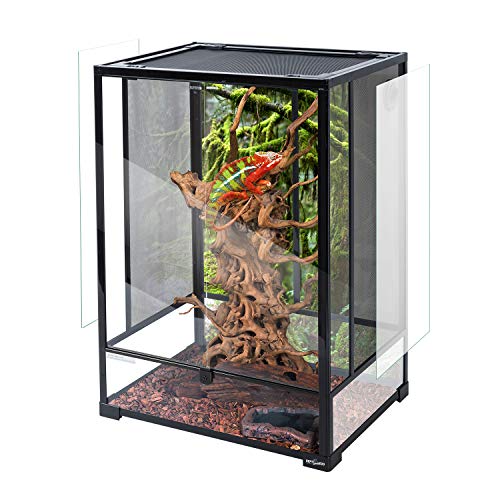
REPTI ZOO Tall Glass Terrarium 24x18x36
Best for an adult crested gecko that needs vertical climbing space.
- 24 by 18 by 36 inches
- Front opening doors
- Screen top for ventilation
Why we pick it
- The 36 inch height clears the vertical space most keepers use for adults
- Front doors let you work inside without disturbing a climbing gecko
Keep in mind
- Glass runs cooler near the top, so add a raised basking branch close to the light

Josh’s Frogs Crested Gecko Vivarium Plant Kit 18x18x24
Best for keepers building a planted, self cleaning setup.
- 18 by 18 by 24 inches
- Plant kit for a bioactive build
- Sized for one adult crested gecko
Why we pick it
- Bundles the plants a bioactive build needs into one order
- The 24 inch height still meets the vertical space adults need
Keep in mind
- Costs more than buying a bare tank and building the bioactive layer yourself

Exo Terra Glass Terrarium
Best for a juvenile crested gecko or a keeper short on space.
- Available in small tall, small wide, large and large extra tall sizes
- Front opening doors
- Raised screen top
Why we pick it
- The size range lets you match the tank to age instead of overbuying
- Front access suits daily misting and feeding
Keep in mind
- Check that the door latch and background panel are secure before adding a gecko
- Confirm the model you choose has enough top ventilation for humidity
For a full setup bundle that adds lighting and hides to a tank like these, see our crested gecko starter kit picks.
Frequently Asked Questions
Can a 10 gallon tank work for a crested gecko?
A standard 10 gallon tank is wider than it is tall, which is the wrong shape for this arboreal species. It may suit a hatchling briefly, but the gecko should move to taller housing well before it reaches juvenile size.
How tall does the enclosure need to be?
Twenty four inches is the standard height for a single adult, and 18 inches is the lowest figure any veterinary sheet allows. Many keepers use 30 to 36 inch tall terrariums instead, since extra height adds more climbing routes and a wider temperature gradient from top to bottom.
Do crested geckos need live plants?
Live plants are not required. Silk plants and secured branches provide the same hiding and climbing function. Live plants are more common in bioactive builds, where they also help regulate humidity.
How often should crested gecko substrate be changed?
A non bioactive substrate such as paper towel or a coconut fiber blend is usually spot cleaned as needed and fully replaced every few weeks to a month. A properly running bioactive substrate is not replaced on a schedule at all, since the clean up crew and plants process waste continuously.
Can juvenile and adult crested geckos share an enclosure?
This is not recommended. Size mismatches lead to food competition. The larger gecko can injure or outcompete the smaller one for basking spots and hides.
Juveniles stay in their own sized enclosure until they reach a comparable adult size.
What size enclosure do two crested geckos need?
No veterinary sheet gives a figure for two animals. Keepers who cohouse two females typically use something noticeably larger than the single adult minimum, often 18 by 18 by 36 inches or bigger. Duplicate hides, branches and feeding stations matter as much as the extra floor space.
Sources
- The Reptile Database: Correlophus ciliatus. https://reptile-database.reptarium.cz/Correlophus/ciliatus
- Animal Diversity Web: Rhacodactylus ciliatus (crested gecko). animaldiversity.org
- Arbor View Animal Hospital (Catherine Love, DVM): Crested Gecko care resource. arborviewah.com
- Aurora Animal Hospital: Crested Gecko Caresheet. Aurora Animal Hospital PDF
- PetMD (veterinarian reviewed): Crested Gecko Care Sheet. petmd.com
- Long Island Birds and Exotic Veterinary Clinic: Crested Gecko Care Guide. birdexoticsvet.com