Explore all 7 supporting guides
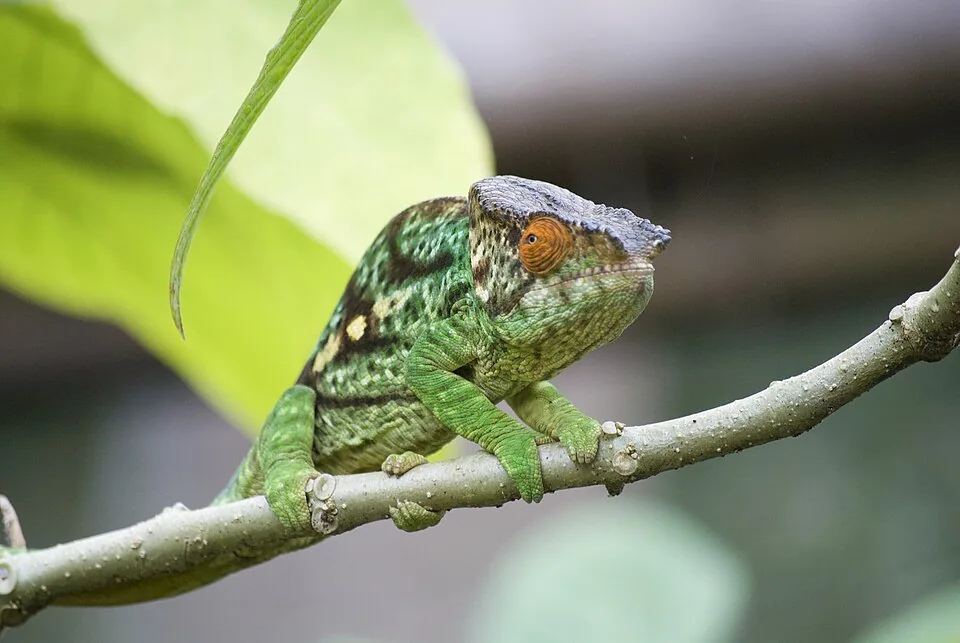
At a glance: The panther chameleon (Furcifer pardalis) is a large, color changing lizard from Madagascar. Males show blue, red, green, or orange tones, depending on their bloodline. Adults reach roughly 17 to 22 inches nose to tail, and males run far bigger and brighter than females.
Wild lifespans are short. A well kept captive male can live five years or more.
They need a tall screen enclosure, strong UVB lighting, daily misting, and gut loaded insects. Most keepers treat them as a display animal, not a lizard to handle often.
As an Amazon Associate, Lizardist earns from qualifying purchases. Some product links on this page are affiliate links.
Few reptiles on earth carry color like the panther chameleon. It is one of the most recognizable lizards in the pet trade for that reason. Males can shift between deep blues, fiery reds, grassy greens, and bright oranges.
Which colors an individual shows often depends on where its ancestors came from on Madagascar. A panther chameleon is not a beginner pet in the usual sense. It needs specific heat, light, and humidity to thrive, and it does not want to be held.
For a keeper willing to build a proper setup, though, few lizards offer this much visual reward. Wild populations have even taken hold outside Madagascar. Escaped pets founded a breeding population in Broward County, Florida, first documented in 2008.
What Is a Panther Chameleon
The panther chameleon, scientific name Furcifer pardalis, was first described by naturalist Georges Cuvier in 1829. It belongs to the family Chamaeleonidae, the true chameleons. Its genus, Furcifer, is covered more broadly on our chameleons page and is found only on Madagascar and nearby islands.
In the wild, this animal lives in the lowland, dry forests of northern and northeastern Madagascar. It favors open, sunlit edges along rivers and roads rather than deep forest shade. It also occurs on several offshore islands, including Nosy Be, Nosy Mitsio, and Nosy Komba.
It has been introduced to Reunion Island. It does not occur naturally on Mauritius, despite occasional confusion with that island.
Genetic and color pattern studies have found something striking. This single species actually contains somewhere between 9 and 15 distinguishable regional groups, or clades, across its Madagascar range.
That variation is exactly why a panther chameleon looks so different from one population to the next. It is also why the pet trade sorts animals by locality name, rather than treating the species as one uniform animal.
Panther Chameleon Care Overview
Caring for a panther chameleon means recreating a warm, bright, humid forest edge inside a screen cage. The core needs are a tall, well ventilated enclosure, strong UVB lighting, and a daily temperature gradient. Add regular misting and a varied diet of gut loaded feeder insects dusted with calcium.
This is not a lizard that tolerates shortcuts. Skipping UVB or running the wrong temperatures leads quickly to metabolic bone disease. That mistake is a common complaint among new chameleon keepers, according to veterinary sources.
Get the setup right from day one, though, and a panther chameleon is genuinely low maintenance day to day. Chameleons are also solitary by nature. They should always be housed alone.
Two chameleons, even a male and female, kept together will stress each other through constant visual threat displays. One animal per cage is a firm rule among experienced keepers and veterinarians alike.
Enclosure Setup for a Panther Chameleon
Panther chameleons need height more than floor space. They are strictly arboreal and spend their lives climbing through branches and foliage.
A screen or mesh enclosure is standard. Good airflow prevents the stagnant, overly damp conditions that lead to respiratory infection, a topic covered in more depth on our housing guide.
A single adult male does well in an enclosure around 2 feet wide by 2 feet deep by 4 feet tall. Females can use something slightly smaller.
Fill the space with sturdy branches at varied angles. Add live or artificial plants dense enough to offer visual cover, since a chameleon that cannot hide from a perceived threat stays stressed.
Live plants such as pothos, ficus, or hibiscus help hold humidity. They also give the animal somewhere to sleep at the top of the cage each night, its natural resting posture.
A solid mesh floor or loose, chemical free substrate makes cleanup easier. It also lowers the risk of impaction from swallowed material.
| Enclosure factor | Recommended range |
|---|---|
| Minimum size, adult male | Roughly 24 x 24 x 48 inches, taller is better |
| Minimum size, adult female | Roughly 18 x 18 x 36 inches |
| Enclosure type | All screen or mostly screen for airflow |
| Housing | One chameleon per enclosure, always |
Heating and Lighting
Every panther chameleon needs a basking spot, a cooler ambient zone, and true UVB light, such as from the Arcadia ProT5 Kit Forest 6%. The Merck Veterinary Manual notes that UVB in the 290 to 300 nanometer range drives vitamin D3 production in diurnal lizards. That in turn controls how well the body uses dietary calcium.
Choosing the right bulbs and fixtures is covered on our gear guide. A basking branch should run several degrees warmer than the rest of the enclosure. Aim for the low 80s Fahrenheit for most adults, with cooler zones allowed to drop into the 70s.
Night temperatures should fall noticeably. A natural night drop supports normal metabolism and sleep behavior in reptiles generally. Our heating and lighting guide covers the full gradient.
Linear or compact fluorescent UVB tubes should sit within about a foot of the basking branch. Replace them roughly every 9 to 12 months, since UVB output fades well before the bulb stops producing visible light.
A full 12 hour light and dark cycle mirrors a tropical day length, and that is standard practice. Chameleons are visually driven animals, so natural sunlight offered outdoors in a secure enclosure is a valuable supplement. It should never fully replace a controlled indoor setup in most climates.
What Panther Chameleons Eat
Panther chameleons are insectivores. Animal Diversity Web describes wild ones as opportunistic hunters that feed almost entirely on terrestrial invertebrates. They rarely touch plant material, even by accident. Our diet guide covers gut loading and supplement timing.
In captivity, a rotating menu covers most nutritional bases. Crickets, roaches, silkworms, hornworms, and black soldier fly larvae, all discussed on our feeding hub, work well together.
Research summarized by the Association of Reptilian and Amphibian Veterinarians found something useful. Panther chameleons maintained good body condition and reproduced successfully on roughly 30 to 50 adult crickets per week, once those crickets were properly gut loaded.
Gut loading means feeding insects a nutritious diet for a day or two before offering them to the chameleon. It is not optional.
The same research found that crickets loaded with 1 to 4 percent calcium and 50 to 100 IU of vitamin A per gram supported healthy panther chameleons. Low vitamin A diets, by contrast, produced clear deficiency signs.
Dust feeder insects with a calcium supplement, such as Zoo Med Repti Calcium without D3, at most feedings. Use a calcium plus vitamin D3 product, or a separate multivitamin, only a few times a month, since oversupplementation carries its own risks.
Fresh water should always be available as moving droplets, never a still dish. These lizards drink almost entirely by licking water off leaves.
Panther Chameleon Health
Two health problems come up most often with panther chameleons: metabolic bone disease and vitamin A related disorders. Both trace directly back to lighting and diet.
Metabolic bone disease develops when weak UVB or poor calcium intake forces the body to pull calcium from the skeleton. Bones end up soft, bent, or easily fractured.
Veterinary case records document a range of problems tied to vitamin A deficiency in panther chameleons. These include eye problems, respiratory infections, neurological signs, spinal kinking, and difficulty shedding.
Deficient animals also showed a buildup of hemipenal plugs in males. A cryptosporidiosis case has been documented in a panther chameleon too, a reminder that gut parasites deserve monitoring, especially in animals losing weight despite eating.
Dehydration is another common issue, since chameleons will not reliably drink from a standing water bowl. A missed misting schedule for even a few days can leave one sunken eyed and lethargic.
Automated misting or drip systems are worth the investment for consistency. Our health guide covers warning signs across lizard species in more detail.
Any panther chameleon that stops eating should see a reptile veterinarian promptly. The same goes for one that keeps its eyes closed during the day, breathes with an open mouth, or shows swelling around the jaw or limbs.
These animals hide illness well. By the time symptoms are obvious, a problem has often been building for a while.
Panther Chameleon Behavior
Panther chameleons are solitary and territorial by nature, and that shapes almost everything about how they act in captivity. In the wild, males patrol and defend individual ranges.
Color signals mood and status to rivals and potential mates. It is not purely for camouflage.
A calm chameleon usually shows steady, muted color and stays relaxed on its perch. A stressed or threatened one darkens and flattens its body side on.
It may hiss, gape, or rock back and forth. All of these are clear signals to back off.
These lizards are diurnal. They are active by day and sleep at night near the top of their enclosure, where leaf cover offers some protection.
Their eyes swivel independently, letting them scan for insects and threats at the same time. Their tongue can extend well beyond body length to snatch prey in a fraction of a second.
Keepers weighing a panther chameleon against a carpet chameleon or a Senegal chameleon will find similar handling rules apply across the group. Handling should stay minimal.
Most panther chameleons tolerate being coaxed onto a hand for a quick check. Frequent handling raises stress hormones and offers the animal little benefit, unlike more social reptile species.
Breeding Panther Chameleons
Breeding is demanding and best left to keepers with real experience. It involves separate setups, careful conditioning, and real risk to the female.
In the wild, breeding activity concentrates in the warmer months from around January through May. Cooler months bring a lull in activity.
Females reach sexual maturity remarkably early, sometimes by around 6 to 7 months old. They can lay clutches of roughly 10 to 46 eggs after mating.
Sources differ somewhat on exact incubation length. Figures range from about 6 months up to nearly 8 months, depending on temperature, so keepers should expect a long wait either way.
A female receives no help raising her eggs. She digs a nest chamber, buries the clutch, and walks away.
The eggs are left entirely on their own until they hatch and dig out. Anyone comparing breeding difficulty across the group, including the Parson’s chameleon and Meller’s chameleon, will find panther chameleons breed far more readily in captivity.
Repeated clutching takes a real physical toll. Multiple sources note that egg laying stress is a major reason captive females tend to have shorter lifespans than males.
Anyone considering breeding needs to plan for calcium support and recovery time between clutches. Close monitoring for egg binding matters too.
Panther Chameleon Size and Lifespan
Adult panther chameleons are a genuinely large chameleon species. University of Florida IFAS Extension puts total length at about 12 to 22 inches.
Males are consistently larger, more colorful, and more heavily built than females. Females stay noticeably smaller and duller, typically in shades of tan, pink, peach, or muted orange.
Compare it with relatives like the veiled chameleon or Jackson’s chameleon for size and casque differences. A swollen tail base is a reliable way to identify a male.
That swelling houses the paired reproductive organs called hemipenes. Lifespan differs sharply between the wild and captivity, and between males and females.
Most wild panther chameleons survive only one to two years past maturity. Captive males kept well can live past five years.
Captive females tend to live shorter lives, often two to three years. Repeated egg production takes a physical toll, even without a male present to fertilize the eggs.
Sources vary on the exact upper end of captive male lifespan. Some cite up to seven years under excellent care, so treat any single number as an estimate rather than a guarantee.
Panther Chameleon Colors and Locality Forms
Panther chameleons are not divided into morphs the way ball pythons or leopard geckos are. Instead, breeders and researchers group them by locality, the specific region of Madagascar a bloodline traces to.
Each region tends to produce a recognizable color signature in males. Animals from Nosy Be, Ankify, and Ambanja in the northwest commonly show vivid blue tones.
Those from Ambilobe, Antsiranana, and Sambava in the north often display red, green, or orange. Sometimes these colors combine on the same animal.
Lines from Maroantsetra and Tamatave on the east coast lean toward red. The flap necked chameleon and Oustalet’s chameleon show far less locality based variation by comparison.
These are general tendencies, not fixed rules. Genetic studies have found meaningful overlap and finer subdivision within these broad locality groups.
A chameleon sold under a locality name is a reasonable guide to expected adult coloration. It is not a guaranteed outcome, since individual animals still vary. Our morph database covers color variation across many lizard species for comparison.
What a Panther Chameleon Costs
A panther chameleon is a mid range investment compared to many common pet lizards, both up front and over time. Young, unsexed, or common colored animals sit at the lower end of the market.
Adult males from a well documented, sought after locality bloodline command a significant premium. Beyond the animal itself, the setup is the bigger real cost.
That includes the enclosure, screen cage, branches, plants, UVB fixture, basking bulb, and misting or drip system. A thermometer and hygrometer, all listed on our gear guide, round out the list, and often cost more than the lizard itself.
Ongoing expenses include feeder insects, gut loading supplies, and calcium and vitamin supplements, such as Zoo Med Reptivite. Bulbs need replacing every 9 to 12 months.
Veterinary care adds to the total as well. A checkup with a reptile veterinarian shortly after purchase is worth budgeting for, along with funds set aside for illness related to husbandry mistakes.
Frequently Asked Questions
What is a panther chameleon?
A panther chameleon is a large, color changing lizard, scientific name Furcifer pardalis, native to Madagascar. Males are known for bright, locality specific coloring in blue, red, green, or orange, while females stay a muted tan or pink.
Is a panther chameleon a good pet?
A panther chameleon suits a keeper who wants a striking display animal rather than one to hold. It also suits someone willing to maintain precise heat, UVB, and humidity.
It is a poor fit for anyone wanting a hands on, cuddly reptile. Our choosing guide can help compare it against calmer species.
How big does a panther chameleon get?
Adult males typically reach the upper end of about 12 to 22 inches in total length, according to University of Florida research. Females stay smaller and lighter bodied throughout their lives.
How long does a panther chameleon live?
Captive males commonly live past five years with good care. Captive females usually live shorter lives, often around two to three years, largely due to the toll of repeated egg laying.
Do panther chameleons need UVB light?
Yes, UVB light is essential for a panther chameleon. It drives vitamin D3 production needed to process dietary calcium, and without it, animals commonly develop metabolic bone disease.
What do panther chameleons eat?
Panther chameleons eat gut loaded feeder insects such as crickets, roaches, silkworms, and hornworms, dusted regularly with calcium. They are strict insectivores that rarely take any plant material.
Sources
- Reptile Database: Furcifer pardalis. https://reptile-database.reptarium.cz/species?genus=Furcifer&species=pardalis
- Animal Diversity Web, University of Michigan: Furcifer pardalis. https://animaldiversity.org/accounts/Furcifer_pardalis/
- University of Florida IFAS Extension: Panther Chameleon (Furcifer pardalis), EDIS UW501. https://ask.ifas.ufl.edu/publication/UW501
- Merck Veterinary Manual: Management and Husbandry of Reptiles. https://www.merckvetmanual.com/exotic-and-laboratory-animals/reptiles/management-and-husbandry-of-reptiles
- Association of Reptilian and Amphibian Veterinarians: 1997 Proceedings, Captive Management, Breeding, and Common Medical Problems of Chameleons. https://cdn.ymaws.com/members.arav.org/resource/resmgr/Files/Proceedings_1997/1997_07.pdf
- IUCN Red List: Furcifer pardalis assessment. https://doi.org/10.2305/IUCN.UK.2011-2.RLTS.T172955A6947909.en