Explore all 76 supporting guides
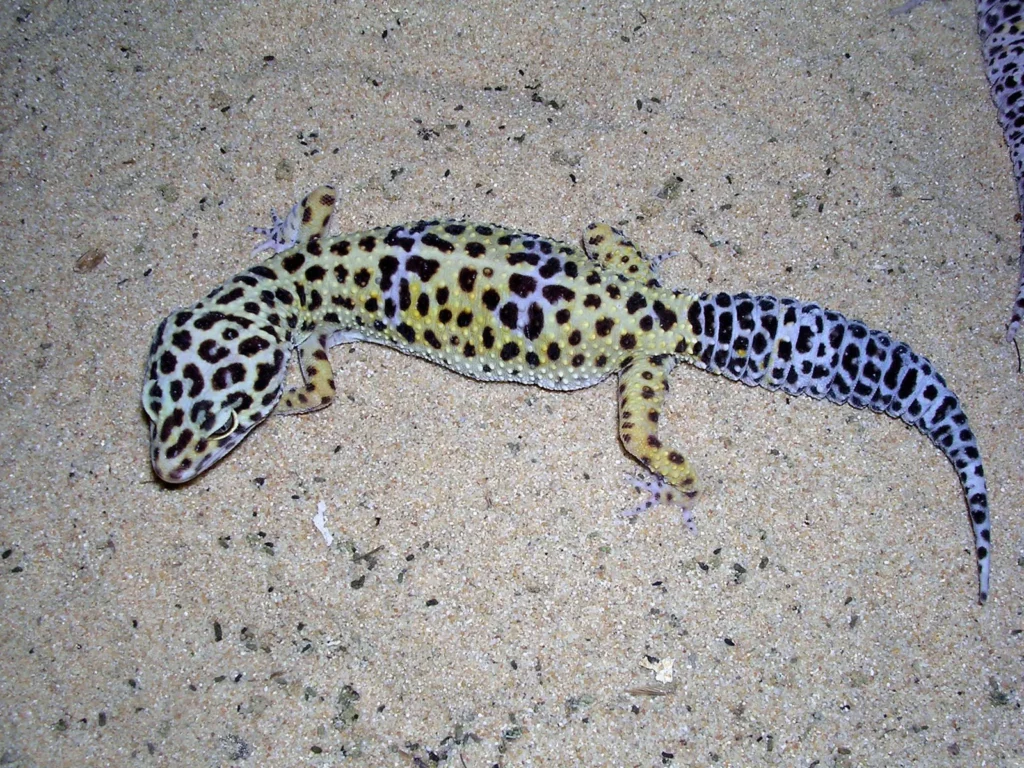
The leopard gecko is a small, ground dwelling gecko with a spotted coat and clawed toes. It has movable eyelids it can blink, a trait that sets it apart from most other gecko species. Its scientific name is Eublepharis macularius.
It comes from the rocky deserts and dry grasslands of Afghanistan and Pakistan. Its range reaches into northwest India as well. Few animals have shaped the modern pet reptile hobby as much as this one.
The leopard gecko is widely seen as the beginner reptile that made keeping lizards mainstream. It remains one of the most kept lizards in the world today.
At a glance: Adult size is around 7 to 10 inches nose to tail. Most animals settle near 8 inches.
Captive lifespans of 15 to 20 years are common with good care. Some individuals live past 20.
They eat insects, not vegetables. They do not need deep water for swimming, just a shallow bowl kept full.
As an Amazon Associate, Lizardist earns from qualifying purchases. Some product links on this page are affiliate links.
Leopard Gecko Care Overview
Leopard gecko care comes down to a few habits done consistently. Keep a warm, dry enclosure with a temperature gradient. Offer a varied insect diet dusted with calcium, and give the gecko a hide on both the warm and cool ends.
Get those right and this gecko is genuinely low maintenance. That reputation is a big reason the wider gecko family gets recommended to first time keepers.
New keepers rarely make one big mistake. Instead it is small habits that cause problems: loose sand swallowed with prey, a tank kept too cool from an undersized heat mat, or crickets left loose overnight to nibble a sleeping gecko’s toes.
A single adult leopard gecko does fine alone. Males are territorial and should never share an enclosure. Mixing sexes leads to constant breeding, so most keepers house one gecko per tank.
Compared with arboreal geckos that climb glass and bark, a leopard gecko spends nearly all its time on the ground. That single difference changes the whole enclosure layout. It favors floor space and low, sturdy hides over tall branches.
Enclosure Setup
A young leopard gecko can start in a 10 gallon tank. It will outgrow that quickly. Current keeper consensus favors a 20 gallon long tank, roughly 36 by 18 inches of floor space, as the practical minimum for an adult.
Many keepers now go larger. Leopard geckos are ground dwelling, so they use floor space more than height.
Substrate is one of the most debated parts of leopard gecko keeping. Loose, dry sand or calcium sand carries a real impaction risk if a gecko swallows it while hunting. Many care sheets, including veterinary clinic handouts, recommend reptile carpet, paper towel, newspaper, aspen, cypress mulch, or coconut fiber instead.
Some experienced keepers use fine, compacted bioactive substrate once a gecko is a healthy adult with strong feeding instincts. This is not a beginner setup. A simpler substrate removes one variable from a young gecko’s health.
Every enclosure needs at least three hides. One goes on the warm side, one on the cool side, and one is a humid hide filled with damp moss or coconut fiber to help with shedding.
Add a shallow water dish and a few climbing branches or rocks. Give the gecko enough loose decor to choose its own comfort zone.
General reptile housing guidance about tank materials, screen versus glass tops, and ventilation applies here too. Low humidity needs make ventilation a bigger factor for this species than for many tropical geckos.
Heating and Lighting
Leopard geckos need a temperature gradient, not one flat number. A common target is a warm side around 88 to 90 degrees Fahrenheit at the basking spot. The cool side runs around 75 degrees, with overall ambient temperature falling between 70 and 85 depending on the spot in the tank.
Most keepers heat from below with an under tank heater or heat mat. Leopard geckos naturally absorb heat from warm rock and sand. They do not bask under an overhead lamp the way a bearded dragon does.
A thermostat is not optional. Without one, a heat mat can overheat and burn a gecko that cannot escape it.
Humidity should sit around 30 to 40 percent in the main enclosure. A more humid microclimate inside the humid hide supports smooth shedding. Too little humidity leads to dehydration and stuck shed, while too much can push toward respiratory infection.
A hygrometer is worth the small cost. Veterinary references do not all agree on the number, and some allow humidity as high as 60 percent, so treat the range as a guide rather than a hard rule.
For decades, the hobby assumed leopard geckos did not need UVB light because they are active mostly at night, though many keepers now add a low output tube such as the Arcadia ShadeDweller ProT5 Kit 7%.
A peer reviewed study on leopard gecko physiology found something different. Despite being nocturnal, they still use UVB radiation to synthesize vitamin D3 in their skin.
That finding has shifted current best practice. Most keepers now offer a low level UVB bulb rather than skipping it entirely.
A low output UVB tube should let the gecko move toward or away from it. That gives the animal a choice without forcing high intensity light on a species built for dim, sheltered spaces.
A basic reptile gear setup for this species covers a thermostat, an under tank heater, a low output UVB tube, and a digital thermometer with a probe. Together those cost far less than treating a burn or a case of metabolic bone disease later.
What Leopard Geckos Eat
Leopard geckos are insectivores. In the wild they hunt scorpions, centipedes, spiders, and beetles.
In captivity that translates to a rotating menu: crickets, mealworms, dubia roaches, and superworms as staples, with occasional waxworms as a treat rather than a regular food.
Feeder insects should be gut loaded with fresh vegetables before they are offered. Dust most feedings with a calcium powder, and use a calcium powder with vitamin D3, such as Zoo Med Repti Calcium with D3, a couple of times a week, depending on how much UVB exposure the gecko gets.
Feeding frequency changes with age. Hatchlings and young juveniles eat daily. Subadults eat every other day, and adults eat roughly every two to three days, adjusted to keep the tail plump without letting the gecko become overweight.
A shallow, stable water dish should stay filled at all times. Leopard geckos drink standing water and lick droplets, so daily misting is not required the way it is for some tropical geckos. Light misting can still help during shedding.
Never feed insects too large for the gecko’s head. Oversized prey is a common cause of impaction and regurgitation.
As a rule of thumb, prey should be no wider than the space between the gecko’s eyes. The broader feeding guide for lizards covers gut loading and supplement schedules in more depth for keepers running multiple species.
| Feeder insect | Best use | Notes |
|---|---|---|
| Crickets | Staple | Good movement to trigger a feeding response, but escapees can bite a sleeping gecko |
| Dubia roaches | Staple | High in protein, quiet, easy to gut load |
| Mealworms | Regular | Convenient to store, harder exoskeleton, best for larger juveniles and adults |
| Superworms | Regular | Larger prey item for bigger geckos, feed in moderation |
| Waxworms | Occasional treat | High fat, useful for underweight geckos but not a staple food |
Common Health Problems
Metabolic bone disease is the most serious and most preventable problem in pet leopard geckos. It develops from too little calcium, an unbalanced calcium to phosphorus ratio, or not enough vitamin D3.
Signs include soft jaw bones, tremors, swollen limbs, or a gecko that struggles to stand. Stuck shed is the other frequent issue, usually tied to humidity that runs too low.
Retained shed around the toes can cut off circulation over time. A humid hide helps, and a brief lukewarm soak can help a stubborn shed finish cleanly.
Impaction, a blockage in the digestive tract, most often comes from loose substrate or oversized feeder insects. Signs include a lack of appetite, a swollen belly, and straining without producing waste.
A vet care sheet from a reptile focused clinic lists three common reasons leopard geckos end up in the exam room: respiratory infection from incorrect humidity, dehydration from humidity that stays too low, and metabolic problems from insufficient warmth.
Any gecko that stops eating for more than a few days needs attention. The same goes for noticeable weight loss, labored breathing, discharge from the nose or mouth, or visible bone deformity.
A reptile veterinarian should see these cases rather than waiting it out at home. The site’s reptile health section covers warning signs and when a home fix is enough versus when a vet visit is warranted, across species.
Behavior and Temperament
Leopard geckos are crepuscular to nocturnal. They are most active at dusk, dawn, and through the night, and they spend daylight hours tucked into a hide.
This makes them a quiet daytime pet. Activity noticeably picks up once the lights go down.
They are generally calm and tolerate gentle handling better than many lizard species. That temperament is a big part of why they became the classic starter gecko.
Even so, a gecko fresh out of the box needs time to settle. Regular handling should wait until it is eating well and comfortable in its new home.
Like several other lizards, a leopard gecko can drop its tail if it feels seriously threatened or grabbed. This defense is called autotomy.
The tail regrows, but the replacement usually looks different. It tends to be shorter, more bulbous, and less detailed in pattern than the original.
The tail also doubles as a fat reserve. A thick, carrot shaped tail is a good sign of body condition.
A thin, shriveled tail usually means the gecko has been underfed or is recovering from illness. Leopard geckos also lick their eyes, chirp or squeak when startled or during breeding season, and eat their own shed skin. All of these are normal behaviors, not signs of a problem.
Breeding
Breeding leopard geckos takes planning, not an accidental pairing. Females need adequate size and body condition first, typically around 16 to 24 months old in captive bred lines.
Breeding an underweight or immature female risks egg binding and long term health damage. A female lays roughly two eggs per clutch, repeating every two to four weeks across a breeding season.
That can add up to several clutches and a dozen or more eggs in a single year. That reproductive output is part of why calcium demand runs so high in breeding females.
Eggs are typically incubated in the low to high 80s Fahrenheit in a humid incubation medium. Hatching takes roughly 45 to 55 days at about 82 degrees, and longer at cooler temperatures.
Incubation temperature also influences hatchling sex in this species, a trait shared with several other reptiles. Breeding is also how the huge range of leopard gecko color and pattern morphs came about, built up over decades of selective pairing by hobbyists and breeders.
Anyone considering breeding should research genetics, egg care, and hatchling husbandry thoroughly first. It is a significant commitment well beyond basic pet keeping.
Lifespan and Size
Adult leopard geckos typically reach around 7 to 10 inches from nose to tail tip. About 8 inches is the common average, and 10 inches is considered large for the species.
Growth slows considerably after the first year. Most geckos reach close to full size by 18 to 24 months.
Lifespan is one of the leopard gecko’s biggest selling points as a pet. Captive animals commonly live 15 to 20 years with consistent care, and well documented individuals have lived past 20. Some veterinary references put the upper end at 25 to 30 years, which is unusually long for an animal this small.
Some reported average lifespans look much lower. That is largely because they include geckos that died young from poor husbandry, illness, or accidents, not a reflection of what a well cared for animal can reach.
A stable enclosure, correct temperatures, and steady feeding do more to extend a leopard gecko’s life than any single product.
Leopard Gecko Morphs
Leopard geckos have one of the largest color and pattern morph catalogs of any commonly kept reptile. It is the product of decades of selective breeding, not anything found in the wild.
Wild type leopard geckos are yellow to tan with dark spots. Morphs can shift that base color, remove the spotting, or change the pattern entirely.
Albino lines show how deep this goes. Tremper albino, Bell albino, and Rainwater albino all look broadly similar, but they come from three separate, genetically distinct mutations.
That distinction matters if a breeder wants to combine traits predictably. Other well established morphs include Mack Snow, which cools the base color toward white and gray, and Blizzard, which removes pattern almost entirely.
Tangerine pushes toward deep orange. Enigma is a pattern morph known for a distinctive speckled look.
Enigma carries a documented complication. Some Enigma lines are associated with a neurological condition often called Enigma wobble syndrome, which causes balance and coordination issues of varying severity.
This is a known concern among breeders. It is a good reason to buy from someone who can speak honestly about a given animal’s lineage.
For a pet buyer, morph mainly affects appearance and, often, price. A snow morph and a wild type animal need the same enclosure, temperatures, and diet.
Cost of Owning a Leopard Gecko
The gecko itself is usually the smallest expense over its lifetime. Basic morphs tend to sell for modest prices.
Rare or combination morphs from established breeders command far more. Purchase price can vary enormously depending on genetics and pattern rather than any single fixed figure.
The bigger, ongoing cost is the setup and its upkeep. That includes a properly sized enclosure, a thermostat controlled heat source, a UVB fixture and bulb replacements, substrate, hides, a water dish, calcium and vitamin supplements, and a steady supply of feeder insects.
Feeder insects and supplements are the recurring cost that adds up over a 15 to 20 year lifespan. This adds up to more than any single piece of equipment over time.
Budgeting for occasional veterinary visits matters too. Reptile focused vets are less common, and their visits often cost more than a routine cat or dog checkup.
Because leopard geckos live so long, it is worth thinking about total cost across two decades rather than just the price tag on day one.
Leopard Gecko vs Other Popular Geckos
A leopard gecko is often the first gecko someone considers, but it is not the only beginner friendly option. The table below compares it with three other geckos commonly kept as pets.
| Species | Activity | Handling | Housing style |
|---|---|---|---|
| Leopard gecko | Nocturnal | Generally tolerant of gentle handling | Ground dwelling, wide floor space |
| Crested gecko | Nocturnal | Tolerant but can jump when startled | Arboreal, vertical space and branches |
| African fat tailed gecko | Nocturnal | Calm, similar temperament to leopard geckos | Ground dwelling, higher humidity needs |
| Tokay gecko | Nocturnal | Defensive, not a handling pet | Arboreal, tall enclosure with hides |
The African fat tailed gecko is the closest relative in day to day care. It shares a similar body plan and calm temperament, but it needs noticeably higher humidity than a leopard gecko’s dry setup.
Keepers who want a gecko that climbs and rarely needs handling often look at the mourning gecko instead. It is a display animal more than a handling pet.
Anyone deciding between several species can also check the site’s broader guide to choosing a pet lizard. It walks through handling tolerance, enclosure space, and time commitment across many species, not just geckos.
Frequently Asked Questions
Is a leopard gecko a good first reptile?
Yes, it is one of the most commonly recommended starter reptiles because of its manageable size, calm temperament, and relatively simple care needs. It still requires correct heating, humidity, and diet to thrive, so it is beginner friendly, not maintenance free.
Do leopard geckos need UVB lighting?
Research shows leopard geckos can use UVB radiation to produce vitamin D3 despite being nocturnal. Current best practice is to offer a low level UVB bulb even though the species was once thought not to need one, alongside dietary vitamin D3.
How big of a tank does a leopard gecko need?
A hatchling can start smaller, but most keepers move to a 20 gallon long tank or larger by adulthood. Floor space matters more than height for this ground dwelling gecko, and larger setups are increasingly common.
Why is my leopard gecko’s tail shaking or wagging?
Tail wagging or shaking usually signals hunting focus, excitement, or mild stress rather than danger. A rapidly vibrating tail alongside other defensive behavior can precede tail dropping, but a relaxed, slowly waving tail during feeding is normal.
Can leopard geckos live together?
Two males will fight and should never share an enclosure. Housing a male with females usually leads to frequent, uncontrolled breeding, so most keepers house leopard geckos individually.
How long do leopard geckos live?
With consistent care, 15 to 20 years is a realistic and commonly reported lifespan, and some individuals live past 20. Shorter reported lifespans in some data usually reflect poor husbandry rather than a hard ceiling for the species.
Sources
- The Reptile Database: Eublepharis macularius (Blyth, 1854). https://reptile-database.reptarium.cz/species?genus=Eublepharis&species=macularius
- Animal Diversity Web, University of Michigan: Eublepharis macularius. https://animaldiversity.org/accounts/Eublepharis_macularius/
- Journal of Comparative Physiology B, via ScienceDirect: The nocturnal leopard gecko (Eublepharis macularius) uses UVb radiation for vitamin D3 synthesis. https://www.sciencedirect.com/science/article/pii/S1096495920301007
- LafeberVet: Basic Information Sheet: Leopard Gecko. https://lafeber.com/vet/basic-information-for-leopard-gecko/
- River Side Animal Hospital: Leopard Gecko client care sheet. https://myriverside.vet/wp-content/uploads/2024/01/client-info-care-sheet-Leopard-Gecko.pdf