Explore all 5 supporting guides
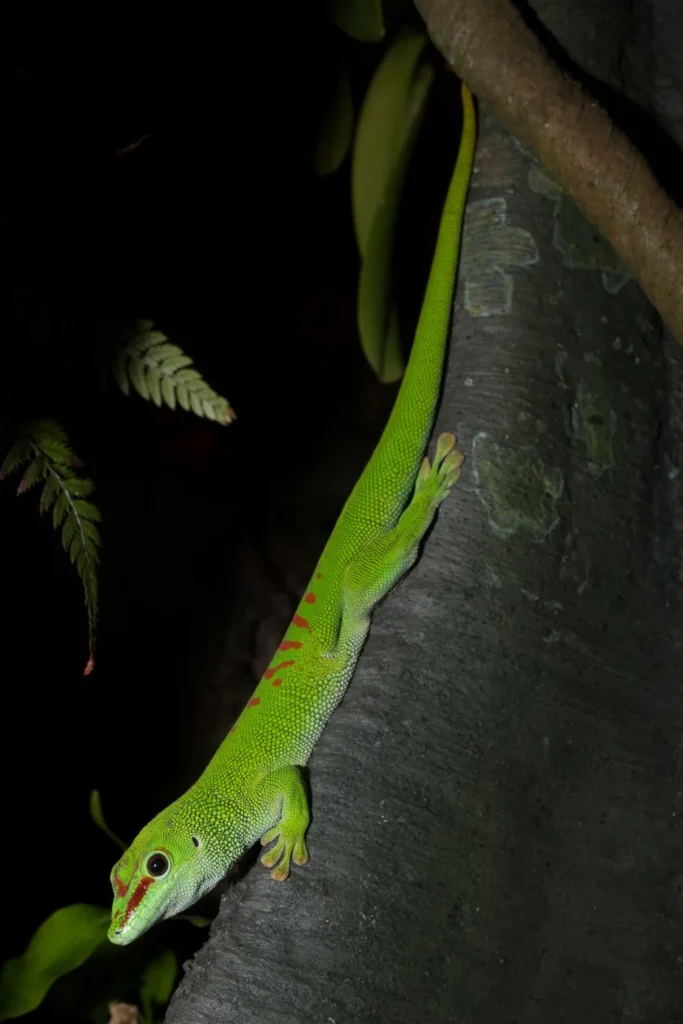
At a glance: The giant day gecko is a large, bright green arboreal lizard from northern Madagascar. It reaches 9 to 11 inches long. It needs a tall, humid, planted enclosure with strong UVB and warm days.
It is not a handling pet. With good care it can live 10 to 15 years.
As an Amazon Associate, Lizardist earns from qualifying purchases. Some product links on this page are affiliate links.
The giant day gecko is one of the largest members of the genus Phelsuma. It is a lizard built for climbing, basking, and holding its own patch of foliage. Adults show electric green skin and a red stripe from nostril to eye, with red spots or bars down the back.
Wild populations come from the forests and towns of northern Madagascar. A giant day gecko in a well kept vivarium looks almost identical to one clinging to a mango tree on Nosy Be. Scientifically it is Phelsuma grandis, once lumped in with Phelsuma madagascariensis before researchers split it out by size, color, and range.
It is sometimes sold as madagascar giant day gecko or grandis day gecko. Older listings occasionally still use the combined name.
Keepers should confirm they are buying Phelsuma grandis and not a similar looking gold dust day gecko or another day gecko. Size and care needs differ across the group.
Giant Day Gecko Care Overview
Good giant day gecko care comes down to four things: height, humidity, heat, and light. This species is strictly arboreal, so vertical space matters more than floor space. It also needs a daily humidity cycle, a hot basking spot, and a cooler zone to retreat to.
Reliable UVB across a large part of the enclosure matters too. This gecko is fast, easily stressed, and prone to dropping its tail. It does best in a hands off setup where the keeper manages the environment rather than the animal itself.
Most of the work happens at setup. Build the enclosure right, and day to day care becomes misting, feeding, and watching for problems.
Enclosure Setup for a Giant Day Gecko
A single adult needs a tall, well ventilated enclosure. Keepers commonly cite an 18 by 18 by 24 inch minimum.
Most prefer 24 by 24 by 36 inches or larger for a calmer animal. Screen or hybrid glass and mesh enclosures work well, since this gecko relies on airflow to avoid respiratory problems.
Live or artificial plants, cork bark, and branching should fill the space from the substrate up to the canopy. This gecko spends almost all its time off the ground. Broad leafed plants like pothos, dracaena, or ficus give both climbing structure and hiding spots.
Substrate should hold some moisture without staying soggy. Coconut fiber, orchid bark, or a bioactive mix with springtails and isopods are common choices. A shallow water dish helps, but daily misting is the main water source, since day geckos usually drink droplets off leaves.
A broader look at tank setup, lighting rigs, and misting equipment across species is in Lizardist’s housing guide and gear guide.
| Enclosure element | Typical range |
|---|---|
| Minimum size, single adult | 18 x 18 x 24 in (larger strongly preferred) |
| Daytime ambient temperature | 78 to 82 F (26 to 28 C) |
| Basking spot temperature | 88 to 92 F (31 to 33 C) |
| Nighttime low | 70 to 75 F (21 to 24 C) |
| Humidity | 50 to 70 percent, with daily misting |
Heating and Lighting Needs
Giant day geckos are heavy sun baskers in the wild. Captive lighting needs to do real work.
Most keepers run a UVB tube across a large section of the canopy. A 5.0 to 7 percent output tube, such as the Arcadia ProT5 Kit Forest 6%, is common in a mesh or screen enclosure.
Position the tube so the gecko can bask within the manufacturer’s recommended distance. A basking bulb or ceramic heat area should create a warm perch around 88 to 92 F. The rest of the enclosure should stay cooler so the animal can move to regulate its own temperature.
Sources and keepers differ somewhat on the exact basking number. A digital thermometer or temp gun is the only reliable way to confirm real numbers in a given setup. Photoperiod should follow a natural cycle, roughly 12 hours of light and 12 of darkness, with lights off overnight.
What Giant Day Geckos Eat
In the wild, this species eats insects, other small invertebrates, soft ripe fruit, and flower nectar and pollen. It occasionally takes a small vertebrate if the chance comes up. That omnivorous diet carries over directly into captivity.
Most keepers offer a commercial powdered gecko diet, mixed with water into a paste, several times a week. This is supplemented with gut loaded insects, commonly crickets or roaches, dusted with a calcium and vitamin D3 supplement.
Occasional soft fruit like mashed mango or banana can round out the diet. Insects and a complete commercial gecko diet should not be replaced by fruit alone. Females that are laying eggs need extra calcium, since frequent egg production can drain their reserves quickly.
Lizardist’s feeding guide covers gut loading and supplement schedules that apply across most insect eating lizards.
Common Health Issues
Metabolic bone disease is the most serious and most preventable problem in captive day geckos. It comes from insufficient calcium, insufficient UVB, or both over time.
Signs include a soft or swollen jaw, trouble climbing, and bent or wobbly limbs. It needs a reptile veterinarian rather than home treatment.
This species drops its tail readily when grabbed or badly stressed. The regrown tail is usually shorter and less patterned than the original. Toe and tail injuries also happen when two geckos are housed together and fight, which is common between males.
Low humidity can cause incomplete sheds, especially around the toes. That can cut off circulation if it is not resolved. Any gecko that stops eating, loses weight, or shows discolored skin patches should see an exotics veterinarian promptly, since reptiles hide illness well.
Lizardist’s health guide covers warning signs and when a vet visit cannot wait.
Behavior and Temperament
Giant day geckos are alert, fast moving, and almost entirely arboreal. They spend their time on branches, bark, and glass rather than the ground. They lack eyelids and are often seen licking their own eyes clean, a normal behavior rather than a sign of illness.
Males are strongly territorial and will fight if housed together, sometimes fatally. Adult males should always be kept alone or with females, never with another male. Even a male and female pairing needs enough space and visual breaks so the female can retreat if she is not receptive.
This is not a species that tolerates regular handling well. It startles easily and moves in short fast bursts. It also drops its tail readily, more like a crested gecko or gargoyle gecko than a docile leopard gecko.
Breeding the Giant Day Gecko
Breeding activity in the wild runs from roughly January through July, with a peak in late winter. Captive conditions can shift the timing somewhat. Females lay pairs of eggs repeatedly through the season rather than a single clutch, often gluing them to bark, leaves, or the enclosure itself.
Incubation runs roughly 47 to 80 days depending on temperature. Research on the genus points to temperature dependent sex determination, meaning incubation temperature can influence hatchling sex ratios.
Because of this repeated egg laying, breeding females face real risk of calcium depletion and egg binding. A calcium rich diet and proper UVB are the safeguard. Our breeding guide covers timing and incubation in more depth.
Hatchlings are tiny, fast, and fragile. Keepers usually raise them separately from adults with smaller feeder insects and careful humidity management. They rejoin a group setup once large enough.
Lifespan and Adult Size
Adult giant day geckos typically reach 9 to 11 inches (23 to 28 cm) in total length, including the tail. The largest recorded specimens approach 12 inches. Females tend to run smaller than males, and this species is one of the largest in the entire Phelsuma genus.
In captivity, keepers commonly cite 6 to 10 years. The Smithsonian’s National Zoo puts typical captive lifespan closer to 15 years.
Good husbandry is the difference between those two figures. Wild lifespan is thought to be under 6 years, since the species faces predation and habitat disturbance there.
Cost of Owning a Giant Day Gecko
The gecko itself is usually the smaller expense. Typical asking prices in the pet trade run roughly 40 to 120 dollars, depending on color intensity, size, and source. Color forms with heavier red or blue markings tend to sell toward the higher end.
The bigger cost is the setup. A tall, ventilated enclosure, UVB lighting, a basking bulb, planting, and a misting system add up.
Together they commonly run into several hundred dollars before the gecko is even added. Ongoing costs include feeder insects, supplements, gecko diet powder, and replacement bulbs, since UVB output drops well before a tube visibly burns out.
Anyone still deciding between this species and another arboreal gecko can compare setups in Lizardist’s choosing a lizard guide.
Giant Day Gecko Colors and Forms
The giant day gecko does not have formally recognized genetic morphs the way ball pythons or leopard geckos do. Instead, the trade describes animals by locality or color intensity. Labels include high red, high blue, or names tied to a region of Madagascar like Ankarana or Nosy Be.
These labels usually describe natural variation or selective breeding for saturated color rather than a distinct mutation. Buyers should treat locality names as a general guide to appearance, not a guaranteed genetic line. Lizardist’s broader morphs guide explains how these color terms work across different lizard groups.
Frequently Asked Questions
Is a giant day gecko a good pet for beginners?
It can work for a beginner who is comfortable with a display animal rather than a handling pet. The setup demands real attention to humidity, heat, and UVB. It suits someone ready to learn husbandry rather than someone who mainly wants to hold their lizard.
Can you house two giant day geckos together?
Two males should never be housed together, since they are territorial and will fight. A male and female pair, or a single animal, is the usual setup. Even paired geckos need enough space for the female to get away if needed.
Do giant day geckos bite?
They can bite if they feel cornered or overly handled, though bites are usually a quick pinch rather than a serious injury. The bigger handling risk is tail loss. This species drops its tail easily when stressed.
What is the difference between a giant day gecko and a gold dust day gecko?
The giant day gecko, Phelsuma grandis, is noticeably larger, reaching up to about 11 inches. The gold dust day gecko stays closer to 5 to 6 inches. Both are Madagascar natives with bright green coloring, but their size and territorial intensity differ.
Why is my giant day gecko licking its eyes?
This species has no eyelids, so it licks its eyes to keep them clean and moist. It is normal behavior. On its own, it is not a sign of illness.
Is it legal to keep a giant day gecko?
In most places, captive bred giant day geckos are legal to keep as pets. The genus Phelsuma is widely regulated under international wildlife trade rules, so wild collected animals and cross border sales can involve permits. Buyers should always choose captive bred animals from a reputable source.
Sources
- Reptile Database: Phelsuma grandis. https://reptile-database.reptarium.cz/species?genus=Phelsuma&species=grandis
- Smithsonian’s National Zoo and Conservation Biology Institute: Madagascar giant day gecko. https://nationalzoo.si.edu/animals/madagascar-giant-day-gecko
- Animal Diversity Web, University of Michigan: Phelsuma madagascariensis (the day gecko complex that included P. grandis). https://animaldiversity.org/accounts/Phelsuma_madagascariensis/
- CITES: The CITES Appendices. https://cites.org/eng/disc/species.php