Explore all 17 supporting guides
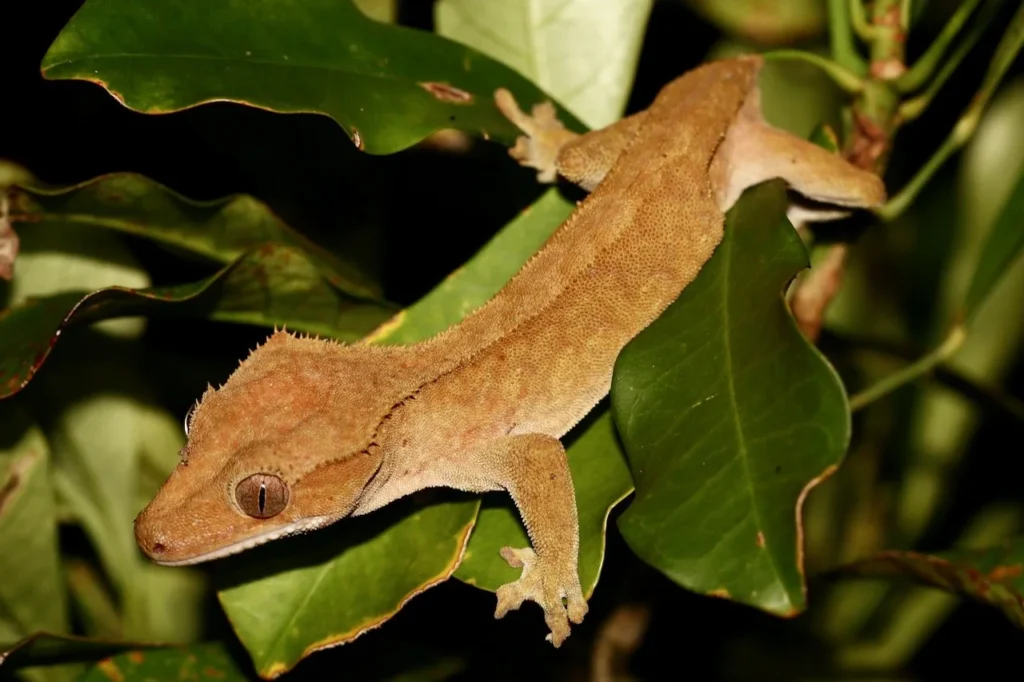
The crested gecko is a small, big eyed lizard from the forests of New Caledonia. Keepers prize it for a calm nature, simple care and almost no need for a heat lamp.
At a glance: The crested gecko, Correlophus ciliatus, is a small arboreal lizard native to New Caledonia. It is also called the eyelash gecko for the fringed scales above its eyes.
Adults reach about 7 to 9 inches long. They live 15 to 20 years or more in captivity.
Most thrive at room temperature without a heat lamp. A single adult does well in an enclosure at least 18 by 18 by 24 inches. It eats a powdered fruit and insect diet and gets misted daily for humidity.
As an Amazon Associate, Lizardist earns from qualifying purchases. Some product links on this page are affiliate links.
It gets its common name from a soft fringe of scales above each eye. That fringe gives it a permanently surprised look. The species name, ciliatus, refers to that fringe, and so does the eyelash gecko nickname.
Scientifically it is Correlophus ciliatus. It is one of the most popular pet lizards in the world today. That is despite once being thought extinct for most of the twentieth century.
The species belongs to the wider world of pet geckos. That group also includes the ground dwelling leopard gecko and the closely related gargoyle gecko, another New Caledonian native.
The crested gecko has an unusual modern history. Scientists once believed the species had gone extinct, with no confirmed sighting for decades.
A small population turned up again in 1994 on Île des Pins, a New Caledonian island. Breeders quickly began working with the rediscovered animals, and captive bred crested geckos are now among the most widely bred pet lizards in the world.
The wild picture is less rosy. The IUCN Red List assesses the species as Vulnerable, mainly because of habitat loss and introduced predators. Nearly every crested gecko in the pet trade is captive bred, so keeping one puts no pressure on wild populations.
Crested Gecko Care Overview
Crested gecko care rests on three things. A tall, planted enclosure comes first. Stable room temperature, steady humidity and a simple powdered diet round out the basics.
Unlike many popular pet lizards, cresties do not need a basking lamp to survive. A low level UVB bulb, such as the Arcadia ProT5 Kit Forest 6%, is still good practice for most keepers today.
They are nocturnal and arboreal. That means they rest by day and become active after dark, climbing rather than digging or basking.
Handling should stay gentle and brief at first. A startled crested gecko can drop its tail, and that tail never grows back.
New keepers often find a crested gecko easier than a leopard gecko in some ways. There is no heat lamp to manage.
There is a tradeoff, though. There is diet powder to mix, plants to maintain and a fast, jumpy animal to work around during cleaning.
Anyone still choosing between species can compare options first. The choosing a pet lizard guide helps before settling on a crested gecko.
Enclosure and Habitat Setup
Crested geckos are arboreal, so the enclosure should be taller than it is wide. A single adult does well in a terrarium at least 18 inches wide and deep, and 24 inches tall.
Many keepers now house adults in 20 gallon vertical tanks or larger bioactive setups. Juveniles start smaller, often around 10 to 12 inches tall, and move up as they grow.
| Life stage | Minimum enclosure size | Notes |
|---|---|---|
| Hatchling | 10 x 10 x 12 in | A smaller space helps a hatchling find food |
| Juvenile | 12 x 12 x 18 in | Move up once the gecko eats reliably |
| Adult | 18 x 18 x 24 in | Larger is fine, especially in bioactive setups |
Glass terrariums with front opening doors are standard. A secure screen top matters too, since crested geckos jump well and can push through small gaps.
Substrate choices range widely. Paper towel suits quarantine or medical setups. Coconut fiber, sphagnum moss or a full bioactive soil mix suit a planted, self cleaning enclosure better.
Loose substrate carries a small risk of impaction if a gecko swallows some while eating. Many keepers feed from a shallow dish rather than off the ground to reduce that risk.
Décor should include plenty of climbing structure. Cork bark rounds, branches, vines and sturdy plants like pothos or ficus all work well.
Crested geckos rest against vertical surfaces during the day, often flattened against a leaf or piece of bark. Vertical clutter matters more here than floor space.
Bioactive setups often add a cleanup crew of springtails and isopods. These tiny invertebrates break down waste and leftover food, which keeps a planted enclosure healthier with less manual cleaning.
The broader reptile housing guide covers substrate, ventilation and materials in more depth. It suits readers setting up their first terrarium.
Heating and Lighting
Crested geckos come from a mild, humid forest climate. They do best between about 72 and 78°F. If a basking spot is offered at all, it should stay no warmer than roughly 82°F.
Heat above about 85°F can be dangerous, and it can be fatal within a short time. Many keepers run crested gecko enclosures with no added heat source, relying on stable room temperature instead.
Night temperatures can drop into the high 60s without any issue. That mirrors natural conditions in the species’ native forest.
In a warm climate, or during a summer heat wave, keepers may need to cool a room. Heating rarely becomes the concern. Fans, air conditioning or a cooler part of the house can all help.
Humidity should sit around 40 to 50 percent between mistings. A daily misting pushes it to 70 to 80 percent for a few hours, then the enclosure should dry back down. Constant sogginess invites skin and respiratory problems.
Lighting matters more for photoperiod and plant health than for heat. A low output UVB bulb, roughly 5 to 7 percent, is increasingly recommended as good practice. Most keepers run it on a 12 hour cycle.
Crested geckos have historically been bred without any UVB at all, using dietary vitamin D3 instead. Many breeders still keep them that way successfully.
A plant safe grow light works well if live plants are part of the setup. A combined UVB and daylight fixture can support both the plants and the gecko. Either way, temperature control matters more for this species than for many other pet lizards.
Overheating is one of the most common preventable causes of death in captivity. A reliable thermometer near the warmest point is worth the small cost.
What Crested Geckos Eat
In the wild, crested geckos are omnivores. They eat insects, soft fruit and nectar as they move through the forest canopy at night.
In captivity, most keepers rely on a commercial crested gecko diet powder, such as Repashy Crested Gecko Diet (Complete/Original). It gets mixed with water into a smooth paste. Keepers usually offer it in a shallow dish two to four times a week.
These powdered diets include the protein, calcium and vitamins a crested gecko needs. Many breeders raise geckos from hatchling to adult on this diet alone.
It is widely considered the simplest and most nutritionally complete option available for the species. Most keepers treat it as the dietary base rather than an occasional extra.
Many keepers also offer live insects once or twice a week. Dubia roaches, crickets and black soldier fly larvae are common choices for enrichment and extra protein.
This matters most for growing juveniles and breeding females. Insects should be gut loaded first. If they are not paired with a complete powder, dust them with calcium and vitamin D3 too.
Fresh fruit can be offered occasionally as a treat. Mashed mango, papaya, banana or fig all work well in small amounts.
Citrus fruit and its juice should be avoided. They are too acidic and can upset digestion.
Fresh water should be available at all times in a shallow dish. Daily misting also gives geckos a chance to lick droplets from leaves and glass. That is how they drink most naturally in the wild.
The broader lizard feeding guide covers gut loading, dusting and portion sizing across species. It suits keepers new to insect eating reptiles.
Common Health Issues
Metabolic bone disease is the most serious and most preventable problem in crested geckos. It comes from too little calcium or vitamin D3 over time.
A complete powdered diet, or a properly dusted insect diet, largely prevents it. Appropriate lighting adds another layer of protection.
Tail loss, called autotomy, happens when a stressed or firmly grabbed gecko drops its tail as a defense. Unlike a leopard gecko, a crested gecko does not regrow the lost tail.
The loss is permanent, but most tailless adults adapt fine. Many pet cresties live full, healthy lives without one.
Floppy tail syndrome is a bend or kink that can develop over time. It often results from a gecko resting against flat glass instead of climbing structure. Plenty of branches largely prevent the problem.
Shedding problems usually trace back to humidity that runs too low. Retained skin around the toes or tail tip can lead to toe loss if it goes unaddressed.
Impaction is a blockage in the digestive tract. It can result from a gecko swallowing loose substrate along with food, especially in young, food driven animals.
Feeding from a dish rather than the enclosure floor reduces this risk. Careful substrate choice for juveniles helps too.
Stuck shed is another common concern, especially around the toes, eyes and tail tip. A humid hide or a light misting before bed usually solves it, and a soak in shallow warm water can help a stubborn patch release.
A reptile veterinarian experienced with geckos should see any lizard that stops eating or loses noticeable weight. The same goes for soft or swollen jaw bones, straining without results, or a shed that will not finish.
The site’s reptile health hub has more detail on recognizing illness early across species.
Behavior and Temperament
Crested geckos are calm, generally easygoing lizards once settled. Many tolerate gentle, brief handling reasonably well.
They are also fast and excellent jumpers. Handling is best done low to the ground or over a soft surface, in case one leaps free.
They are strictly nocturnal. They sleep through the day tucked against a leaf or piece of bark. They become active in the evening to hunt, explore and feed.
New keepers sometimes worry a crested gecko is inactive or sick when it is simply asleep during daylight hours. Checking after dark usually settles that concern quickly.
Crested geckos rarely bite. Most defensive behavior is limited to jumping away or letting out a soft chirp or squeak when startled.
Adult males can be territorial toward other males. They are typically housed alone or with females, never paired with another male in the same enclosure.
Because tail loss is permanent, careful handling matters more with this species than with many other geckos. Letting a gecko walk from hand to hand lowers stress. It also lowers the chance of a dropped tail compared to a firm grip.
Breeding
Crested geckos reach sexual maturity around 12 to 18 months old. Many breeders wait until a female reaches a solid adult weight before pairing her, rather than going by age alone.
In the wild, the breeding season runs roughly 8 to 10 months of the year. Captive breeding tends to follow a similar seasonal pattern for many keepers.
Females lay eggs in pairs, typically burying them in moist substrate. A single female can produce multiple clutches across a season.
Notably, a female crested gecko can store sperm from one mating. She can then continue laying fertile eggs for months afterward.
Eggs usually incubate at room temperature, around 72 to 78°F. Hatching takes roughly 60 to 90 days at those temperatures, and cooler incubation can stretch well beyond that.
Whether incubation temperature sets hatchling sex in crested geckos is still debated among breeders. Most choose a temperature for healthy development speed rather than to control sex.
Breeding should be approached carefully. Repeated clutches can draw down a female’s calcium reserves and overall body condition.
Experienced breeders track weight and calcium supplementation closely through a breeding season. Rest periods between pairings help females recover.
Crested Gecko Morphs and Color Forms
Few pet lizards have as many named morphs as the crested gecko. Decades of selective breeding, since the species reentered the hobby in the 1990s, produced most of them.
Morphs are grouped mainly by pattern and by color. Many individuals combine more than one pattern type.
| Morph or pattern | Typical look |
|---|---|
| Dalmatian | Small dark spots scattered over the base color |
| Pinstripe | Bold straight stripes running down the sides of the back |
| Harlequin | Bold, contrasting patches of color, often on the limbs too |
| Flame | Bright, saturated pattern running up the back like a flame |
| Tiger | Narrow, irregular stripes across the body |
| Patternless | A single solid color with no contrasting pattern |
Base colors range from soft cream, tan and olive to deep red, orange and near black. Crested geckos also show a trait called firing up.
An individual can shift between a duller and a more vivid, contrasted version of its color. Activity, temperature and mood all seem to play a part.
A gecko that looks washed out during the day may fire up to bold, saturated colors once active at night. Keepers often notice this shift most clearly right after the lights go off.
Morph names describe appearance, not separate subspecies. A crested gecko with no notable pattern is sometimes called a normal or classic. It makes just as healthy a pet as a rare, expensive morph.
The site wide morph database tracks color and pattern terms like these across many species, not only crested geckos.
Lifespan and Size
An adult crested gecko typically measures 7 to 9 inches long, including the tail when one is present. Many individuals today live without a tail after an earlier autotomy event.
Weight in adults commonly ranges from about 35 to 50 grams. Females often run slightly heavier than males once mature.
With good care, a crested gecko commonly lives 15 to 20 years in captivity. Some well kept individuals have reportedly lived past 20.
That is a long commitment for what looks like a small, simple lizard. It is worth weighing carefully before bringing one home.
Growth is fastest in the first year. Most crested geckos reach close to adult size by 12 to 18 months old. Genetics and diet quality both influence the timeline.
Cost of Owning a Crested Gecko
A normal or common pattern crested gecko is one of the cheaper pet lizards to buy. Rare, high end morphs from established breeders can cost many times more.
The starter setup usually costs more than the gecko. That covers a tall enclosure, décor, substrate, a thermometer, a hygrometer and initial food supplies.
The final number depends heavily on quality and on whether live plants get included. A bioactive setup with real plants and a cleanup crew costs more upfront.
Adoption through a reptile rescue is another option worth considering. Rehomed crested geckos are sometimes available at a lower cost than buying young from a breeder, and taking one in can suit a keeper who wants to skip the hatchling stage.
Ongoing costs stay relatively low compared to many pet lizards. There is often no heat lamp electricity bill, and diet powder is inexpensive.
Budget for regular crested gecko diet powder and occasional feeder insects. Misting supplies, a humidifier and an occasional vet visit round out the list. These add up gradually rather than all at once.
Because crested geckos live well over a decade, total lifetime cost adds up even though yearly costs stay modest. Factoring in eventual vet visits and enclosure upgrades gives a more realistic picture than the sticker price alone.
Keepers weighing a crested gecko against other easygoing species have options. The burrowing African fat tailed gecko and the colony friendly mourning gecko both make good comparisons. The gear hub also covers equipment costs across species in more detail.
Frequently Asked Questions
What is a crested gecko?
A crested gecko is a small arboreal lizard, Correlophus ciliatus, native to New Caledonia in the South Pacific. It is also called the eyelash gecko, and it ranks among the most commonly kept pet geckos worldwide.
Is a crested gecko a good pet for beginners?
Yes, most keepers consider crested geckos one of the easier pet lizards to keep. They do not need a heat lamp in most homes. They eat a simple powdered diet and tolerate gentle handling reasonably well.
How big does a crested gecko get?
Most adult crested geckos reach about 7 to 9 inches long, including the tail when one is present. Many pet cresties lack a tail after dropping it earlier in life, since the species cannot regrow one.
How long do crested geckos live?
With consistent care, a crested gecko commonly lives 15 to 20 years, and some individuals live even longer. That makes them a bigger commitment than many first time keepers expect from a small lizard.
Do crested geckos need UVB lighting?
Crested geckos have historically been bred successfully without UVB, using dietary vitamin D3 instead. A low output UVB bulb is now commonly recommended as good practice alongside a complete diet.
Why did my crested gecko lose its tail?
Crested geckos drop their tail as a defense when they feel threatened or get grabbed too firmly. The tail does not grow back in this species. A tailless gecko generally adapts well and lives a normal life.
Sources
- The Reptile Database: Correlophus ciliatus. https://reptile-database.reptarium.cz/Correlophus/ciliatus
- NCBI Taxonomy Browser: Correlophus ciliatus. https://www.ncbi.nlm.nih.gov/Taxonomy/Browser/wwwtax.cgi?mode=Info&id=143539
- IUCN Red List: Correlophus ciliatus assessment. https://www.iucnredlist.org/species/176173/123253756
- Carpenter St. Croix Valley Nature Center: Crested Gecko Natural History. https://carpenternaturecenter.org/wp-content/uploads/2020/02/Crested-Gecko-Natural-History-PDF.pdf
- Animal Diversity Web, University of Michigan: Rhacodactylus ciliatus (crested gecko). https://animaldiversity.org/accounts/Rhacodactylus_ciliatus/