At a glance: Bearded dragon supplements cover three jobs. Calcium, such as Zoo Med Repti Calcium without D3, builds bone strength, vitamin D3 helps the body absorb that calcium, and a multivitamin covers what the diet still misses. Dust most feedings for a juvenile, about once a week for an adult, and add a multivitamin once or twice a month.
As an Amazon Associate, Lizardist earns from qualifying purchases. Some product links on this page are affiliate links.
Bearded dragon supplements make up for what a captive menu cannot supply on its own. In the wild, Pogona vitticeps forages across the deserts and scrubland of central Australia. That diet includes a wide mix of plants and insects.
A pet dragon eats a far narrower selection. Calcium, vitamin D3, and a general multivitamin close the resulting gaps. Getting this right helps prevent the metabolic bone disease covered in the common diseases guide.
Why Bearded Dragons Need Supplements
A healthy reptile needs roughly twice as much calcium as phosphorus in its blood. Standard feeder insects run the opposite way. They are naturally low in calcium and high in phosphorus, as the feeder insect list notes.
Left undusted, that imbalance drives metabolic bone disease over time. Wild edible plants can carry roughly twenty times more calcium than phosphorus. That is part of why the plant side of the diet matters as much as the bugs.
Vitamin D3 plays a supporting role. A dragon’s skin makes its own D3 when UVB light, such as from an Arcadia ProT5 Kit Desert 12%, hits it. That D3 is what lets the body absorb dietary calcium instead of passing it through unused.
A dragon under strong UVB, set up per the UVB guide, needs less dietary D3. One under weak or aging bulbs needs more help from a supplement.
Calcium: The Core Supplement
Calcium powder is the bearded dragon supplement every keeper reaches for most often. It comes in two forms: plain calcium, and calcium with added vitamin D3. Plain calcium suits a dragon basking under strong UVB, since the skin already makes D3.
The D3 version fits weaker lighting setups. Even then, it should not be the only source of vitamin D3 in the enclosure. Strong UVB lighting still matters more than any powder.
Frequency depends on age, and sources do not fully agree here. UC Davis recommends calcium three times a week for juveniles and weekly for adults. Reptiles and Research recommends dusting at nearly every feeding while a dragon is still growing fast.
Follow the higher frequency while a dragon is young and active. Taper toward once a week as growth slows near adulthood. This is a normal part of any bearded dragon supplement schedule.
To dust an insect, shake a few feeders with a pinch of calcium powder in a small container. Offer them right away so the powder does not fall off. Greens can get a light dusting too on days without insects.
Watch for shortfall signs using the signs of illness guide. Caught early, a calcium gap is fully manageable.
Multivitamin Supplements
A multivitamin fills in vitamin A and trace minerals that calcium powder does not cover. UC Davis suggests monthly use for juveniles and adults alike. Another care sheet suggests every two weeks for fast growing juveniles instead.
Treat monthly as a safe default. Increase frequency only if a vet recommends it for a specific dragon. This is one area where sources genuinely differ.
Fat soluble vitamins build up in the body rather than flushing out. More is not automatically better here. Dosing a multivitamin, such as Zoo Med Reptivite, too often is the more common mistake, not too rarely.
Gutloading and Feeder Prep
Dusting only reaches the outside of a feeder insect. Gutloading works from the inside instead. Feeding insects a calcium rich diet, such as Repashy Superload or Mazuri Better Bug, for a day or two before offering them raises what a dragon absorbs.
This step matters most for crickets and roaches. Both pass nutrition along fairly quickly. A well fed feeder insect is a better delivery vehicle than an empty one.
Pre dusted or calcium enriched dried feeders, sometimes sold as Calcigrubs, offer convenience. They should not fully replace an independent dusting routine, though. A dried, pre coated insect can lose potency in storage.
A keeper also has no easy way to confirm the exact dose on any single feeding. Treat these products as an extra, not a stand in for the schedule below.
A Sample Schedule for Bearded Dragon Supplements
The table below is a starting point, not a fixed rule. Growth rate, UVB strength, and diet variety all shift the ideal frequency. Check with an exotics vet if a dragon shows any warning sign covered later in this guide.
| Life stage | Calcium (no added D3, with strong UVB) | Multivitamin |
|---|---|---|
| Hatchling and juvenile | Most feedings, tapering as growth slows | Every two to four weeks |
| Subadult | Three to four times a week | Monthly |
| Adult | Once a week | Monthly |
A juvenile shifts toward an adult feeding pattern around the 30 gram body weight mark, described in the growth stages guide. Supplement frequency can taper around that same point.
Reading Supplement Labels and Comparing Products
The Arcadia EarthPro line splits the job into two products. EarthPro Ca covers calcium, and EarthPro A covers a reptile specific multivitamin. Keeping calcium and multivitamin separate, as several brands do, makes each one easier to dose on its own schedule.
ReptAid is marketed as a general wellness or gut support product. It is not a calcium or vitamin source and should not replace either one. Think of it as an add on, not a core bearded dragon supplement.
Reptilinks are a prepared whole prey style feeder, not a bearded dragon powder supplement. They can round out a feeding rotation. They do not remove the need for a normal dusting schedule.
Not every product on a shelf of bearded dragon supplements is worth the price. Check the label closely before buying one.
Look for a plain calcium source, a separate multivitamin listing vitamin A, and a clear expiration date. Powders lose potency over time. A fresh container is a small cost next to everything else in the cost of ownership guide.
Signs of a Supplement Problem
Metabolic bone disease from too little calcium is one of the common conditions in the common diseases guide. Early signs include a softening jaw, tremors, or reluctance to bear weight normally. Any of these calls for a same week vet visit, not a wait and see approach.
Too much of a fat soluble vitamin looks different. It often shows up as lethargy or a drop in appetite. That is not the same as the normal seasonal appetite dip covered in the not eating guide.
If either pattern shows up, bring the exact supplement schedule to the vet visit. Real dosing details let a vet adjust the plan instead of guessing.
Recommended Bearded Dragon Supplements
These are the calcium and multivitamin powders that fit the schedule above. Pick the calcium type that matches your UVB setup, then add a multivitamin in rotation rather than every feeding.
- Best calcium (with UVB)Zoo Med Repti Calcium without D3View on Amazon
- Best for high UVB or outdoor timeRep-Cal Phosphorus-Free Calcium PowderView on Amazon
- Best all in one multivitaminRepashy Calcium PlusView on Amazon
- Best general multivitaminZoo Med ReptiviteView on Amazon

Zoo Med Repti Calcium without D3
Best for daily dusting when your dragon gets adequate UVB.
- Plain calcium carbonate, no added D3
- Fine powder for dusting feeders
- Safe for daily use under UVB
Why we pick it
- Matches the daily dusting rule when UVB is already covering vitamin D3
- Avoids the risk of doubling up on D3 from two sources
Keep in mind
- Only appropriate if your UVB tube is the right strength and within its replacement window
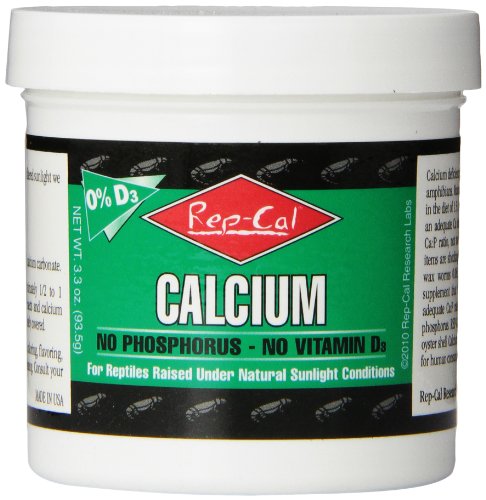
Rep-Cal Phosphorus-Free Calcium Powder
Best for dragons that get strong UVB or regular supervised outdoor sun.
- Phosphorus free calcium carbonate
- No added D3
- Fine texture for dusting
Why we pick it
- A phosphorus free formula supports the wide calcium to phosphorus ratio bearded dragons need
- Pairs well with strong UVB or outdoor basking, where extra D3 is not needed
Keep in mind
- Not the right choice for a dragon without any UVB source

Repashy Calcium Plus
Best for owners who want calcium and vitamins combined for the weekly rotation.
- Calcium plus a full vitamin and mineral blend
- Sold in low, medium and high D3 strengths
- Designed for insectivorous and omnivorous lizards
Why we pick it
- One powder covers the multivitamin dusting listed in the schedule above
- Choosing the D3 strength lets you match it to your UVB setup
Keep in mind
- Do not add a separate high D3 product at the same feeding

Zoo Med Reptivite
Best for a straightforward multivitamin to rotate with plain calcium.
- Multivitamin and mineral powder
- Meant for rotation, not daily use
- Works across most lizard species
Why we pick it
- A simple option for the multivitamin slot in a vet reviewed rotation
- Keeps calcium and multivitamin dosing separate and easy to track
Keep in mind
- Follow a set schedule rather than dusting with it every feeding
Frequently Asked Questions
What supplements do bearded dragons need?
Every bearded dragon needs a calcium supplement and a reptile multivitamin at a minimum. Whether the calcium needs added vitamin D3 depends on how strong the UVB lighting already is.
When do you put supplements on bearded dragon food?
Dust feeder insects just before offering them, since powder brushes off fast once an insect starts moving. Greens can be lightly dusted right before they go in the dish too.
What supplements should I give my bearded dragon as a juvenile versus an adult?
Juveniles need calcium at most feedings and a multivitamin roughly every two to four weeks, since fast growth raises calcium demand. Adults can shift to calcium about once a week and a monthly multivitamin.
Are Reptilinks or Calcigrubs a substitute for a regular calcium powder?
No. Both are convenient feeding products, but neither replaces a dedicated calcium and multivitamin schedule. Dosing from a pre made product is hard to verify or adjust.
Can I use a human or dog multivitamin instead of a reptile one?
No. Reptile multivitamins are built for a bearded dragon’s specific vitamin A, D3, and mineral needs. Other formulas risk the wrong ratios entirely.
What happens if a bearded dragon gets too much supplement powder?
Overdoing calcium with added D3, or a multivitamin, can lead to vitamin toxicity over time. Fat soluble vitamins accumulate rather than clearing out, so stick to the schedule above and let a vet fine tune it.
Sources
- UC Davis School of Veterinary Medicine: Bearded Dragon Care. https://healthtopics.vetmed.ucdavis.edu/health-topics/exotics/bearded-dragon-care
- Animal Diversity Web: Pogona vitticeps. https://animaldiversity.org/accounts/Pogona_vitticeps/
- Reptiles and Research: Bearded Dragon Care Sheet. https://reptilesandresearch.org/care-sheets/bearded-dragon-care-sheet
- PetMD: Bearded Dragon Care Sheet. https://www.petmd.com/reptile/bearded-dragon-care-sheet
- U.S. Fish and Wildlife Service: Central Bearded Dragon (Pogona vitticeps). https://www.fws.gov/species/central-bearded-dragon-pogona-vitticeps