Explore all 474 supporting guides
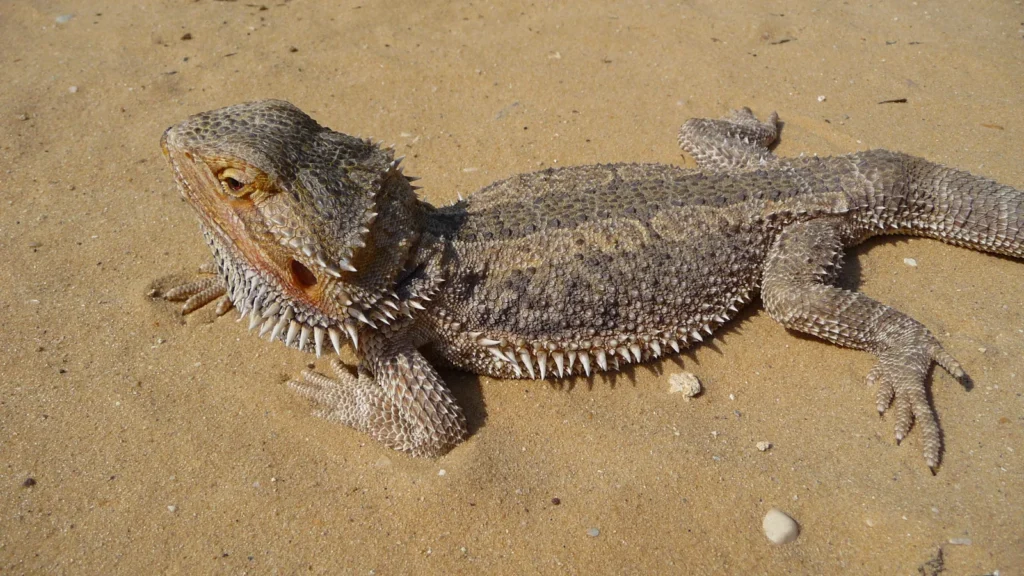
The bearded dragon is the lizard most American reptile keepers picture first. It is a stocky, spiky, sand colored animal. It suns itself on a rock and puffs out a black throat pouch when it feels threatened.
It often looks like it is waving at the person standing in front of its tank. That gesture is actually a social signal, not a greeting, and the behavior section below explains what it really means.
Almost every bearded dragon sold in the United States is the same species. That species is Pogona vitticeps, the central or inland bearded dragon. It comes from the dry interior of eastern and central Australia.
Decades of captive breeding have made it calm and food motivated. A healthy adult bearded dragon grows to roughly 15 to 24 inches nose to tail, depending on the source and the individual. It lives close to a decade with attentive care.
Bearded dragons belong to a wider group of Old World lizards known for basking and bold display behavior. Their closest relatives kept as pets include water dragons and the frilled lizard, all covered together on the site’s dragon group guide.
At a glance: Adult size roughly 15 to 24 inches. Lifespan commonly 7 to 10 years in captivity. Adult enclosure at least 48 inches long, with a basking spot near 88 to 100 degrees and UVB light, such as the Arcadia ProT5 Kit Desert 12%, running most of the day.
As an Amazon Associate, Lizardist earns from qualifying purchases. Some product links on this page are affiliate links.
Bearded Dragon Care Basics
Good bearded dragon care comes down to four things. It needs a big enclosure, a real temperature gradient, working UVB light, and an age appropriate diet. Get all four right and a bearded dragon is genuinely easy to keep happy.
Baby and juvenile dragons need more frequent feeding and smaller insects than adults. Their bones are still forming. Calcium and correct UVB exposure matter most in the first year of life.
New keepers often underestimate the cost and the daily time this lizard needs. Feeding, misting, and checking temperatures take a few minutes twice a day. The lizard also needs supervised time outside the enclosure for exercise.
Anyone comparing lizards before buying can start with the guide to choosing a pet lizard. Close relatives in the same group, like the Chinese water dragon, make a useful comparison for anyone weighing size and space against a bearded dragon.
A healthy dragon at a pet store or breeder should have clear, bright eyes and no crust around the nose or mouth. Its body should look rounded rather than pinched along the spine, and its limbs should support real weight without a visible tremor. A dragon that refuses to open its eyes, seems limp, or has a visibly swollen jaw is worth avoiding.
Housing and Enclosure Size
A single adult bearded dragon needs an enclosure at least 48 inches long. It should be at least 24 inches wide and 18 inches tall. That is close to a 75 or 120 gallon tank footprint.
Bigger is almost always better. These are active, curious animals that walk, dig, and climb through the day. A young dragon can start smaller, but most keepers move straight to the adult size.
Substrate choice matters more than new owners expect. Loose sand or fine bark can be swallowed during feeding and cause a blockage. Many experienced keepers use reptile carpet, tile, or paper liners instead, especially for young dragons.
The enclosure also needs climbing branches, a flat basking platform, and at least one hide. Bearded dragons are semiarboreal in the wild. They spend real time off the ground on branches, stumps, and rocks.
| Feature | Baby (0 to 4 months) | Juvenile (4 to 12 months) | Adult |
|---|---|---|---|
| Minimum enclosure length | 20 to 30 inches | 36 inches | 48 inches |
| Feeding frequency | 2 to 3 times daily | 1 to 2 times daily | Insects a few times a week |
| Rough insect to vegetable ratio | Mostly insects | Around 50% insects | About 25% insects, 70% vegetables |
The full setup, including tank styles and accessories, is covered on the enclosure and housing guide and the gear and equipment guide.
Heating, Lighting, and UVB
Bearded dragons are desert adapted baskers. Getting the temperature and light setup right is arguably the most important part of keeping one healthy. Daytime ambient temperature should sit around 80 to 85 degrees Fahrenheit.
The basking spot should run warmer, generally in the 88 to 100 degree range, such as with a Zoo Med Repti Halogen Basking Spot Lamp. This depends on the bulb and how close the dragon can get to it. Nighttime temperature can drop to about 70 to 75 degrees without extra heat.
A bearded dragon also needs a UVB bulb of at least 5% output. It should sit within about 12 inches of the basking area. Nothing should block the light, since glass and plastic filter out UVB.
UVB lets the dragon make vitamin D3 in its skin. That vitamin D3 lets it absorb calcium from food. Without enough UVB, even a perfect diet will not prevent metabolic bone disease.
Photoperiod should mimic daylight hours. A common pattern is around 8 hours of light in winter and up to 14 hours in spring and summer. UVB tubes lose most of their output long before the visible light fades, so sources recommend replacing the bulb every 3 to 6 months.
Humidity is where sources genuinely differ. Some veterinary references suggest 40 to 60% relative humidity. Others recommend a drier 20 to 40% range that matches this species’ dry native habitat more closely.
In practice, most keepers aim for the lower end of that spread with good ventilation. They only raise humidity briefly during shedding, or for a baby dragon struggling to shed.
What Bearded Dragons Eat
Bearded dragons are omnivores, and their ideal diet changes a lot with age. Babies and juveniles are growing fast and need more protein. Their plates lean heavily toward appropriately sized insects, with chopped greens introduced from a young age.
Adults flip that ratio. They eat mostly vegetables and greens, with insects offered a few times a week rather than daily. Good feeder insects include crickets, dubia roaches, and occasional silkworms.
Feeder insects should never be wider than the space between the dragon’s eyes. Insects that are too large can cause partial paralysis, seizures, or loss of coordination in a young dragon. They can also cause an inability to eat, gut blockages, and in severe cases death.
Leafy greens make a good base for the vegetable portion of the diet. Collard greens, dandelion greens, turnip greens, and mustard greens are common staples. Vegetables high in calcium oxalates, like kale, spinach, cabbage, and chard, should stay occasional rather than daily.
Oxalates bind calcium and can work against the animal’s calcium needs over time. A light dusting of calcium powder on insects is standard practice for most keepers. A calcium powder with vitamin D3, such as Zoo Med Repti Calcium with D3, a couple of times a week is common too, even alongside good UVB.
Fruit can be offered in small amounts as an occasional treat, not a staple. A detailed breakdown of safe foods and feeding schedules by age lives on the site’s feeding guide.
Fresh water should stay available at all times, usually in a shallow, sturdy dish that cannot tip over easily. Many bearded dragons drink more readily from droplets misted onto leaves or tank walls than from a still dish. A light misting also helps young dragons shed cleanly.
Common Health Problems
Metabolic bone disease is the health issue most associated with bearded dragons. It develops when a dragon does not get enough usable calcium. That can come from too little UVB, too little dietary calcium, or too much phosphorus and oxalates crowding calcium out.
The body starts pulling calcium from the bones to keep other systems running. Early signs include a slight softness in the jaw or legs, tremors, or reluctance to move. Any of these signs warrants a visit to a reptile experienced veterinarian.
Impaction, a blockage in the digestive tract, is the other issue keepers ask about most. It is usually caused by swallowed substrate, an oversized feeder insect, or a foreign object. A dragon that stops eating, cannot pass stool, or develops a hard lump along its belly needs a vet visit.
Parasites, particularly coccidia and pinworms, are common in bearded dragons. This is especially true for dragons from large breeding operations or busy pet stores. A fecal exam soon after bringing a new dragon home catches most of these early.
Respiratory infections often link back to temperatures that run too cool or humidity that sits too high for too long. They show up as wheezing, mucus around the nose or mouth, or open mouth breathing unrelated to basking. Any of these signs also calls for a veterinary check.
The site’s general lizard health guide covers warning signs that apply across species. It pairs well with the bearded dragon specific issues described here.
Brumation is a reptile version of hibernation. It is normal in adult bearded dragons and is often mistaken for illness by new keepers. It is triggered by shorter days and cooler temperatures.
A brumating dragon eats little or nothing and sleeps for long stretches. It may bury itself, but it should still look alert when briefly checked. Rapid weight loss, sunken eyes, or real lethargy alongside a refusal to eat still calls for a vet visit.
Behavior and Temperament
Bearded dragons communicate through a small set of visible signals. The beard is an expandable throat pouch lined with spiky scales. It darkens toward black and puffs outward when the dragon feels threatened, is displaying to a rival, or is courting a mate.
A calm dragon usually keeps its beard flat while basking or exploring. Arm waving is one of the most recognizable bearded dragon behaviors. It is a social signal, not a greeting aimed at people.
A dragon lifts one front leg and rotates it in a slow circle. This is typically a submission or acknowledgment gesture toward another dragon, a larger animal, or sometimes a reflection. Head bobbing works differently.
Rapid, sharp bobbing usually signals dominance, most often from males. Slower bowing motions tend to come from females signaling submission. Both behaviors are common and normal to see.
Glass surfing is a behavior keepers frequently ask about online. This is when a dragon repeatedly scratches, climbs, or paces along the glass walls of its enclosure. It is generally treated as a sign of stress rather than a quirky habit.
It is often linked to a reflection the dragon keeps reacting to, or an enclosure that feels too small. A disrupted light schedule or a recent change, such as new substrate, can also trigger it. Covering reflective sides of the tank and rechecking the light schedule are the fixes keepers report helping most.
Individual personality varies quite a bit between dragons. Most tame down well with regular, gentle handling. Many keepers describe their dragon as recognizing feeding time and following movement outside the tank.
Handling sessions go best when kept short at first and built up gradually. Supporting the body fully, rather than grabbing from above like a predator would, keeps a young dragon calmer during those early sessions. A dragon that puffs its beard, hisses, or gapes its mouth during handling needs a break, not more pressure.
Breeding
Bearded dragons reach sexual maturity around 1 to 2 years old. This depends on size and weight more than age alone. In the wild, mating season runs roughly from September through March.
Captive dragons kept under stable indoor conditions can breed at other times of year. Courtship and rivalry both involve the same signals described above. Males flare their beards, bob their heads, circle each other, and sometimes bite lightly.
Females lay a clutch of eggs in a dug burrow. Clutch size varies between sources, with published figures running from about 11 to 30 eggs. Incubation typically takes somewhere between 55 and 85 days, depending on temperature.
Cooler incubation runs longer, and warmer incubation runs shorter. This pattern holds true across most reptile species. Breeding responsibly requires a correctly sized setup for the female, a nesting box with damp substrate, and a dedicated incubator.
It also requires the knowledge to raise a clutch of eggs and hatchlings that will need care of their own. Pairing dragons without a real plan for the resulting eggs is discouraged by veterinary and breeding sources alike.
Lifespan and Size
An adult bearded dragon typically reaches somewhere between 15 and 24 inches long, including the tail. Veterinary sources give the lower end of that range, and field references the upper end.
Males generally grow a bit larger and more heavily built than females. Most of that growth happens in the first year.
A dragon is usually close to full size by 18 to 24 months old. Veterinary sources commonly cite a captive lifespan of 7 to 10 years. Many long term keepers report dragons living into their early teens on excellent care.
There is no single agreed upon maximum lifespan for this species. The wide range reported reflects real variation in husbandry quality, not a flaw in any one source. In the wild, dragons deal with a harsher climate and more predators.
Wild lifespans are generally assumed to run shorter than captive ones. Hard field data on wild longevity is limited.
Growth rate can be a useful early health check for a new keeper. A dragon that stalls in length or weight for weeks at a time, despite regular feeding, is worth discussing with a reptile experienced veterinarian rather than waiting to see if it catches up on its own.
Cost of Keeping a Bearded Dragon
The dragon itself is usually the cheapest part of the hobby. The bigger expense is the equipment. A large enclosure, a strong UVB fixture, a basking bulb, a thermostat, a thermometer, and a hygrometer add up fast.
Substrate and enough branches and hides to furnish the space properly add more. Keepers setting up a full adult enclosure from scratch should expect the initial setup to be a real investment, not an afterthought.
Ongoing costs are smaller but recurring. Feeder insects, fresh vegetables, calcium and vitamin supplements, and replacement UVB bulbs every few months all add up. A dragon that develops metabolic bone disease, impaction, or a parasite load also brings vet costs that can exceed the original setup price.
Getting the husbandry right from day one saves money as well as suffering. Anyone comparing the cost and effort of different lizards can see a broader comparison on the choosing a lizard guide. A rundown of specific equipment lives on the gear guide.
Buying secondhand or upgraded equipment can bring the setup cost down without cutting corners on care. A used enclosure, thoroughly cleaned, works exactly as well as a new one. A fresh UVB bulb is the one piece of gear most keepers should always buy new, since a used tube’s output cannot be verified.
Color Morphs and Varieties
Decades of selective breeding have produced a wide range of bearded dragon color and pattern varieties. These are generally called morphs. Common examples include hypomelanistic dragons, with paler, washed out coloring, and translucent dragons, with a slightly see through skin quality and often darker eyes.
Citrus and red dragons are bred for stronger, more saturated color. Scale texture varies too. Leatherback dragons have visibly smoother, less spiky scales than a standard dragon.
Silkback dragons have essentially no spiky scales at all. They come from breeding two leatherback dragons together. Silkbacks need extra care around humidity and sun exposure, since their skin dries out and sunburns more easily without normal scale coverage.
Many experienced keepers consider breeding for silkbacks controversial for that reason. Whatever the color or scale type, morph does not change the core care this page describes. A silkback or a standard colored dragon needs the same enclosure, heat, UVB, and diet.
More morph photos and terms across several species sit on the site’s morph and color guide.
Frequently Asked Questions
How big of a cage does a bearded dragon need?
An adult bearded dragon needs an enclosure at least 48 inches long, 24 inches wide, and 18 inches tall. A young dragon can start smaller, but most keepers move to the adult size early.
What do bearded dragons eat day to day?
Young dragons eat mostly appropriately sized insects with some chopped greens. Adults eat mostly vegetables and greens, with insects offered a few times a week. Fruit stays an occasional treat.
Why is my bearded dragon glass surfing?
Glass surfing is generally a sign of stress from a reflection, a disrupted light schedule, or a small feeling enclosure. Covering reflective sides and checking the temperature and light setup usually helps.
Is my bearded dragon sick or just brumating?
Brumation is a normal, hibernation like slowdown with reduced eating and long periods of sleep. A dragon losing weight rapidly, with sunken eyes or real weakness, should still see a veterinarian.
How long do bearded dragons live?
Veterinary sources commonly cite 7 to 10 years in captivity. Some well cared for dragons live into their early teens. Lifespan varies a lot based on diet, lighting, and overall care.
Are bearded dragons good for beginners?
Bearded dragons are one of the most commonly recommended lizards for a first time keeper. They are calm and food motivated, but they still need a large enclosure, strong UVB lighting, and consistent daily care.
Sources
- UC Davis School of Veterinary Medicine: Bearded Dragon Care. https://healthtopics.vetmed.ucdavis.edu/health-topics/exotics/bearded-dragon-care
- NC State College of Veterinary Medicine: Caring for Your Pet Bearded Dragon. https://hospital.cvm.ncsu.edu/services/small-animals/nutrition/caring-for-your-pet-bearded-dragon/
- Animal Diversity Web: Pogona vitticeps. https://animaldiversity.org/accounts/Pogona_vitticeps/
- Australian Museum: Central Bearded Dragon. https://australian.museum/learn/animals/reptiles/central-bearded-dragon/
- The Reptile Database: Pogona vitticeps (Ahl, 1926). https://reptile-database.reptarium.cz/species?genus=Pogona&species=vitticeps