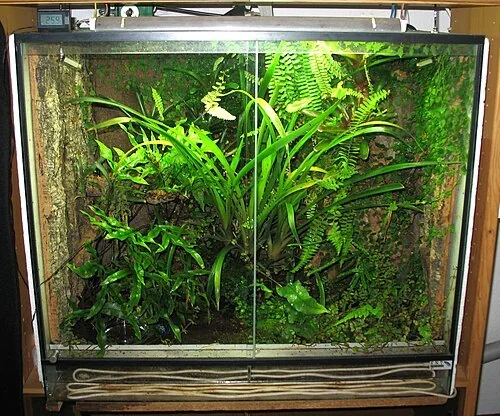
At a glance: A reptile thermometer confirms the basking spot and cool side actually match the target range. Pair a digital probe thermometer with a digital hygrometer near the substrate. Add a UV index meter if the setup uses UVB lighting, and skip analog dial gauges.
As an Amazon Associate, Lizardist earns from qualifying purchases. Some product links on this page are affiliate links.
A reliable reptile thermometer turns a guess into a confirmed setup. Every basking bulb, heat mat, and ceramic heater needs a way to check the temperature it actually produces. Without a reptile thermometer, a keeper is left assuming numbers that can run several degrees off target.
Why Measurement Comes Before Guessing
Reptiles regulate body temperature by moving between warm and cool areas. This behavior is called thermoregulation. It only works if the enclosure gradient matches what the species needs.
A thermostat, such as the Exo Terra Dimming and Pulse Proportional Thermostat, controls the heat source, but it reads air near its own probe. That is not the same as the basking surface an animal sits on. A separate reptile thermometer confirms what the animal actually experiences.
A reptile thermostat prevents overheating. A thermometer and hygrometer confirm the numbers the thermostat and bulbs are producing. Both jobs matter, and neither tool replaces the other.
Which Tool Measures What
Four tools cover every number a reptile enclosure needs. Each one answers a different question, and none of them replaces another.
| Tool | What it measures | Typical accuracy | Best use |
|---|---|---|---|
| Digital probe thermometer | Air or surface temperature at one fixed point | About plus or minus 1 to 2 degrees Fahrenheit | Left in place at the basking spot and cool side |
| Infrared temp gun | Surface temperature wherever it is pointed | About plus or minus 2 to 4 degrees Fahrenheit on matte surfaces, worse on glass and water | Quick spot checks of rocks, branches, substrate |
| Digital hygrometer | Relative humidity of the air near its sensor | About plus or minus 3 to 5 percent relative humidity | Left at animal height on the humid and dry sides |
| UV index meter | UVB output as a UV index value | Reads the same scale as sunlight forecasts | Monthly bulb check at the basking distance |
| Analog dial thermometer or hygrometer | Air temperature or humidity, roughly | Often off by 5 degrees or 10 percent or more | Not recommended |
Digital Thermometers and Probe Placement
A digital thermometer with a wired probe is the standard tool for most enclosures. The display sits outside the tank. The probe clips to the basking branch, the substrate, or the glass.
Place one probe thermometer at the basking spot, a few inches from where the animal rests. Place a second probe on the cool side. This confirms both ends of the gradient, not just one number.
For burrowing species, add a third probe a few inches into the substrate. This tracks belly heat from an under tank heater. Most digital units read within a degree or two of the true temperature.
Avoid the round analog dial thermometers sold as cheap tank accessories. These units are rarely calibrated and can read several degrees off target. Adhesive strip thermometers on the glass are just as unreliable, since they measure the glass itself.
Infrared Temperature Guns and Their Limits
An infrared temp gun, often called a temperature gun for reptiles, gives an instant surface reading from a distance. It works by measuring infrared radiation and converting it to a temperature. For wood, rock, and skin, the factory setting is close enough for daily checks.
The limitation shows up on shiny or reflective surfaces. Glass, metal mesh, and standing water can throw an infrared gun off by several degrees. Point the gun at the actual basking material, not the tank glass.
A published study compared infrared thermography against internal body temperature in hatchling tortoises. During steady and cooling conditions, the two methods agreed closely, with median differences of about one degree Celsius. During rapid warming, the gap widened to five degrees or more, since shell surfaces heat faster than the tissue underneath.
Use an infrared temp gun for quick spot checks across many points. Then confirm the basking spot and cool side with a fixed probe thermometer left in place. The gun scans broadly, while the probe tracks one spot over time.
Reptile Hygrometers and Humidity Gauges
A reptile hygrometer measures moisture in the air. This number matters as much as temperature for species from humid rainforests or dry deserts. A digital humidity gauge with a remote probe gives a continuous reading.
Combination units that show both temperature and humidity on one screen are common and convenient. They cost little more than a single sensor unit. Most pet reptile setups only need one of these per enclosure.
Place the probe away from the water dish, the misting zone, and any fan airflow. Each of those will skew the local reading. A gauge near the substrate, at animal height, gives a more useful number than one mounted high on the lid.
Two hygrometers, one on each side, reveal a humidity gradient. This works the same way two thermometers reveal a temperature gradient. Analog dial hygrometers share the same accuracy problems as analog dial thermometers.
Calibrating Thermometers and Hygrometers
Any thermometer or hygrometer can drift out of calibration over time. Cheaper units drift fastest. A simple check for a probe thermometer is an ice water bath.
Pack a cup with crushed ice and top it up with cold water, then push the probe several inches into the slush without touching the sides. The reading should settle at 32 degrees Fahrenheit, and NIST treats any difference from that value as the measured error. A probe that reads more than 2 degrees off is worth replacing rather than correcting by hand.
Hygrometers can be checked with a salt test. Seal a small dish of damp table salt inside a sandwich bag with the hygrometer. Wait eight to twelve hours in a stable room.
Saturated table salt holds the air in a sealed container at 75 percent relative humidity, measured by NIST at 75.3 percent at 77 degrees Fahrenheit and 75.5 percent at 68 degrees. A hygrometer reading within 3 to 5 percent of that is fine for reptile work. One that reads 10 percent or more off has drifted and should be replaced, since few consumer units can be adjusted.
UV Index Meters and UVB Monitoring
A UV index meter measures UVB output the way a thermometer measures heat. It matters for any species kept under a UVB lighting setup. Bulbs lose output well before they visibly dim.
A fixture that looked fine six months ago may now deliver only a fraction of its original UVB. A reading with a UV index meter is the only way to catch this early. Waiting for visible dimming means months of underexposure first.
The meter used in zoo and veterinary work reads the UV index, the same scale weather forecasts use for sunburn risk. The instrument matters, since a broadband UVB meter reading microwatts cannot tell wavelengths that build vitamin D3 from ones that do not. A UV index meter with a sensor matched to the vitamin D3 action spectrum is the type the published guidance is written for.
Target UV index by species group
Baines and colleagues sorted 254 reptile and amphibian species into four exposure groups, known as Ferguson zones, based on UV index readings taken where each species basks in the wild. The zone gives a target for the reading at the animal’s basking spot, with lower readings elsewhere in the enclosure.
| Zone | Habit | Typical UV index in the enclosure | Peak UV index at the basking spot | Example species |
|---|---|---|---|---|
| 1 | Crepuscular or shade dweller | 0 to 0.7 | 0.6 to 1.4 | Tokay gecko, green tree python |
| 2 | Partial sun, occasional basker | 0.7 to 1.0 | 1.1 to 3.0 | Corn snake, ball python, many anoles |
| 3 | Open or partial sun basker | 1.0 to 2.6 | 2.9 to 7.4 | Bearded dragon, panther chameleon, day geckos |
| 4 | Midday sun basker | 2.6 to 3.5 | 4.5 to 9.5 | Collared lizard, chuckwalla, uromastyx |
For zone 3 and 4 species the same authors describe a basking beam of UV index 3.0 to 5.0 that fades to zero in the shaded parts of the enclosure. Zone 1 and 2 species do better with low, even output from a tube, again with full shade available. Take the reading at the top of the basking surface, at the animal’s back height, not at the bulb.
Check the reading monthly and log it. Replace the bulb once its basking reading drops below the zone range, or on the maker’s schedule, typically every six to twelve months. Do this regardless of whether the tube still lights up.
Mesh between the bulb and the animal cuts the reading, so measure through the screen the bulb will actually shine through. A bearded dragon UVB setup, as a zone 3 species, needs a basking reading of roughly 3 to 5 to support healthy bone growth. A meter confirms that without guessing.
Common Measurement Mistakes
- Relying on the thermostat display alone instead of a separate reptile thermometer at the basking spot.
- Using a dial thermometer or hygrometer instead of a digital probe unit.
- Placing the probe too close to the heat source, which reads air rather than the surface an animal touches.
- Skipping calibration checks on a new hygrometer before trusting its readings.
- Assuming a UVB bulb still works because it lights up, without checking it with a UV index meter.
- Measuring only one spot instead of confirming both ends of the gradient.
What to Look For When Buying
A basic digital thermometer with a single probe costs very little. It covers the basking spot check most enclosures need. A combination thermometer and hygrometer unit with two probes covers both jobs from one display.
This suits most lizard enclosures without extra cost. An infrared temp gun is a useful add on, not a replacement for a fixed probe. It cannot stay in place to track a spot over hours.
A UV index meter is a larger purchase. It usually suits keepers running several UVB setups, or anyone who wants precise confirmation rather than a calendar guess. Building a full reptile supplies kit around accurate tools pays off across every species kept.
Recommended Thermometers and Hygrometers
A reliable reptile thermometer paired with an accurate hygrometer removes the guesswork this guide warns against. The picks below cover the three jobs an enclosure actually needs: a surface check, a probe reading at basking and cool sides, and continuous humidity tracking.
- Best surface checkZoo Med Digital Infrared Temp GunView on Amazon
- Best combo probeZoo Med Digital Combo Thermometer & Humidity GaugeView on Amazon
- Best dedicated hygrometerAcuRite Digital Hygrometer/ThermometerView on Amazon
- Best UVB checkSolarmeter Model 6.2 UVB MeterView on Amazon

Zoo Med Digital Infrared Temp Gun
Best for quick basking and substrate spot checks.
- Instant surface readout
- Handheld, battery powered
- No probe placement needed
Why we pick it
- Confirms the basking surface hits target range in seconds
- Useful for scanning multiple hot spots in one enclosure
Keep in mind
- Reads surface temperature only, never air temperature
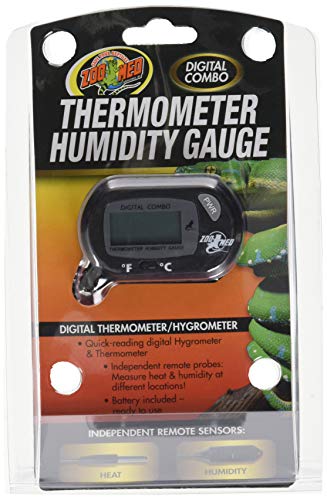
Zoo Med Digital Combo Thermometer & Humidity Gauge
Best for species that need both temperature and humidity tracked at once.
- Wired probe for basking or cool side
- Built in ambient humidity sensor
- Single display for both readings
Why we pick it
- One unit covers chameleons, geckos and most lizards without buying two gauges
- The probe gives a continuous reading, not a single snapshot
Keep in mind
- Its ambient humidity sensor runs less precise than a dedicated hygrometer, fine for general monitoring

AcuRite Digital Hygrometer/Thermometer
Best budget option for general ambient monitoring in any enclosure.
- Ambient temperature and humidity display
- No probe required
- Compact wall or glass mount
Why we pick it
- Gives a fast humidity baseline for any tank without extra setup
- Low cost enough to run one per enclosure
Keep in mind
- Not reptile specific and ambient only, so it will not confirm a basking hot spot

Solarmeter Model 6.2 UVB Meter
Best for confirming a UVB bulb still puts out useful UVB at the basking distance.
- Reads UVB irradiance at basking distance
- Works with any UVB bulb or fixture
- Handheld, reusable across enclosures
Why we pick it
- A meter reading is the only way to know whether a bulb is still delivering after installation, as the UV section above explains
- Catches bulbs that have already faded past useful output
Keep in mind
- Needs periodic recalibration or replacement per the manufacturer schedule
For a full breakdown of humidity gauges by species, see our best reptile hygrometer picks.
Frequently Asked Questions
How many thermometers does one enclosure need?
Most setups need at least two, one at the basking spot and one on the cool side. A third probe in the substrate helps for burrowing species. A heating and UVB setup with multiple heat sources benefits from checking each one separately.
Are infrared temperature guns accurate enough on their own?
An infrared temp gun scans many spots quickly, but only at the instant it is used. A fixed probe thermometer left in place tracks changes over time instead of one moment.
How often should a reptile hygrometer be calibrated?
Check a new unit with a salt test before first use. Repeat the check every few months. Units in a warm, humid enclosure tend to drift faster than one in a drier setup.
What UV index reading should my reptile have?
It depends on the species group. Shade dwellers such as tokay geckos need a peak of about 0.6 to 1.4 at most, while open baskers such as bearded dragons do best with a basking spot reading of about 3 to 5 that fades to zero in the shade. Measure at the animal’s back height on the basking surface.
Why does my analog dial thermometer read differently than my digital one?
Analog dial units use a simple coil that drifts and is rarely factory calibrated with any precision. A digital probe thermometer, checked against an ice water bath now and then, gives a far more dependable number.
Where should a humidity gauge sit inside the enclosure?
Place it at roughly the animal’s height, away from the water dish and any fan airflow. A reading near the top of a screen lid usually runs lower than the humidity at substrate level.
Sources
- Journal of Zoo and Aquarium Research: Baines et al., How much UV-B does my reptile need? The UV-Tool, a guide to the selection of UV lighting for reptiles and amphibians in captivity. https://jzar.org/jzar/article/view/150
- National Institute of Standards and Technology: Verification Methods for Alternative Thermometers, ice point method. https://www.nist.gov/pml/sensor-science/thermodynamic-metrology/mercury-thermometer-alternatives/mercury-thermometer-7
- Journal of Research of the National Bureau of Standards: Greenspan, Humidity Fixed Points of Binary Saturated Aqueous Solutions (1977). https://nvlpubs.nist.gov/nistpubs/jres/81A/jresv81an1p89_A1b.pdf
- National Center for Biotechnology Information: Validating infrared thermography for noninvasive estimation of internal body temperature in hatchling Mojave desert tortoises. https://pmc.ncbi.nlm.nih.gov/articles/PMC13427760/