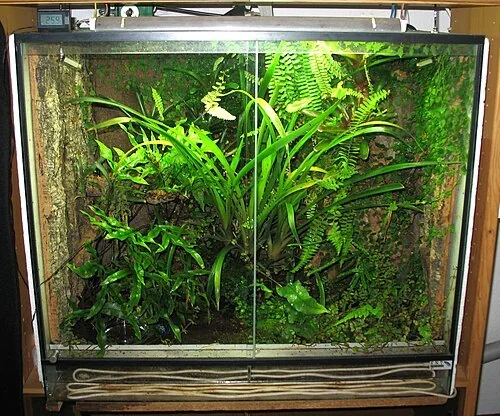
A reptile enclosure is the box that stands in for a wild habitat. It has to hold heat, light, and humidity all at once. Every lizard care plan starts here, because a bad enclosure undoes good feeding and good lighting fast.
At a glance: A reptile enclosure needs a secure, escape proof frame. It needs a heat source that creates a real temperature gradient. Most day active species also need UVB lighting and room to move naturally.
Glass tanks suit dry, arid species best. PVC and wood cages hold heat and humidity better for tropical and larger lizards.
As an Amazon Associate, Lizardist earns from qualifying purchases. Some product links on this page are affiliate links.
What Makes a Good Reptile Enclosure
A good enclosure meets four needs at once. It gives containment, thermoregulation, lighting, and enrichment. Miss any one of those and the animal suffers for it.
Containment means the animal cannot push open a lid. It cannot squeeze through a gap or dig under a wall. Screen lids left unlatched are a common way lizards escape.
Thermoregulation means a warm side and a cool side. The lizard needs to move between them freely. A single heat source in a small tank does not give that choice.
A state operational guide for reptile care calls heat one of the most critical factors in captive survival. Without enough heat, reptiles cannot metabolize food properly.
Lighting matters just as much. UVB lets the skin make vitamin D3 for calcium processing.
Enclosure Materials: Glass, PVC, Wood and Mesh
Glass terrariums are the most common starting point. They work well for desert and arid species like bearded dragons and leopard geckos. Glass is easy to clean and easy to see through.
That said, glass loses heat and humidity fast through the front panel and any screen top. That makes it a poor match for tropical species that need stable, high humidity. A glass tank for a rainforest species usually needs extra help holding moisture.
PVC and coated wood cages hold heat and moisture far better than glass. Many keepers of chameleons and tropical geckos switch to them for that reason. Larger monitors and tegus often end up in PVC enclosures too.
These cages cost more and are less transparent than glass. They also resist warping from humidity far better than untreated wood. A front opening PVC cage makes daily access easier for large, defensive species like tegus.
Mesh or screen cages are mostly used for true chameleons. Chameleons need constant airflow around their bodies more than they need trapped humidity. A mesh cage paired with frequent misting can work well for that one group.
For almost every other lizard, mesh alone is a poor choice. It lets heat and moisture escape too fast for a stable environment.
What Size Lizard Terrarium Does Your Species Need
There is no single formula that fits every species. Anyone promising one exact number for all lizards is oversimplifying the question. Size has to match the species, not a generic rule.
Ground dwelling desert species like bearded dragons and uromastyx need floor space measured in feet, not inches. Adults are commonly kept in enclosures 4 feet long or more.
Arboreal species like crested geckos and day geckos need height more than floor space. They spend almost all their time climbing.
Large monitors and tegus outgrow standard glass tanks entirely. They typically end up in custom built rooms or large PVC enclosures once mature. Research the specific adult size of a species before buying anything.
Juvenile sized starter tanks are a common reason keepers end up buying a second, larger enclosure within the first year. Our guide to choosing a pet lizard covers adult size alongside temperament. Plan the enclosure before bringing an animal home.
A peer reviewed survey of pet snake housing found something worth noting here. Snakes kept in enclosures smaller than their own body length showed more signs of stress.
That research was done on snakes, not lizards. The underlying principle likely applies broadly: bigger than the bare minimum tends to produce a calmer animal.
Heating and Lighting Basics
Every reptile enclosure needs a heat source strong enough to create a real gradient. Overhead basking bulbs, such as the Zoo Med Repti Halogen Basking Spot Lamp, suit species that bask on branches or rocks. Under tank heaters suit species that absorb warmth from the ground instead.
Using the wrong type for a given species risks burns or an animal that never warms up properly. That guidance comes from a state reptile care operational manual written for licensed shelters. It applies just as well to a home setup.
Most day active lizards need UVB lighting to process calcium correctly. The bulb needs replacing on a schedule, even if it still produces visible light, and one state reptile care guide recommends bulbs under six months old. UVB output fades well before the bulb actually burns out.
Bulb distance from the animal matters too. The same guide suggests keeping the basking branch within roughly 12 inches of the bulb.
The exact distance depends on that bulb’s strength. Checking its own chart is worth a few extra minutes.
A thermometer and hygrometer are not optional extras. Stick on strip thermometers are notoriously inaccurate. A digital probe thermometer at both the basking spot and the cool side gives a far more honest reading.
Our reptile gear guide breaks down specific bulb and thermostat recommendations by species.
Humidity and Ventilation
Humidity needs vary enormously across lizard species. A crested gecko or day gecko needs humidity well above what a desert uromastyx can tolerate. Getting this wrong in either direction causes real problems.
On the dry end, low humidity causes dehydration and poor sheds. On the wet end, excess humidity causes skin and respiratory infections. Our lizard health guide covers the warning signs of both and when to call a reptile vet.
A screen or mesh top increases airflow and lets humidity escape. That helps dry species but works against tropical ones.
Covering part of a screen top with plastic or foil tape is a cheap fix. It holds moisture in without buying a new cage.
Misting raises humidity temporarily for species that need a daily spike rather than constant dampness. It can be done by hand or with an automatic system.
A regional government animal welfare guide notes that tropical reptiles depend on regular misting that mimics natural rainfall. That misting also supports normal shedding.
Substrate and Furnishings
Substrate choice depends heavily on species and humidity needs. Reptile carpet and paper towel are simple, low risk options for many species. Neither one carries an impaction risk if accidentally swallowed.
Loose substrates like coconut fiber, cypress mulch, or sand mixes hold humidity better and let burrowing species dig. They carry some ingestion risk with certain feeding methods. They also need more frequent spot cleaning than a simple liner.
Furnishings matter as much as substrate. A state government care guide notes that hide boxes should exist on both the warm and cool sides. A lizard should never have to choose between feeling secure and staying at a comfortable temperature.
Climbing branches, cork bark, and rock ledges give arboreal and rock dwelling species the vertical structure their bodies expect. Visual barriers matter for skittish species too. Partial background coverage on three sides of a glass enclosure can noticeably reduce stress behavior.
Bioactive Enclosures
A bioactive reptile enclosure uses a living substrate ecosystem, such as Josh’s Frogs Tropical BioBedding, to break down waste naturally. Isopods and springtails do most of that work over time. A drainage layer sits below the substrate to prevent standing water and root rot.
Live plants provide cover and humidity in a bioactive setup. The cleanup crew slowly processes shed skin and droppings as they fall. This reduces how much manual spot cleaning the tank needs.
Bioactive setups suit species that tolerate a naturalistic, slightly humid environment. Many geckos, chameleons, and some monitors do well in one. They are not a true shortcut for beginners.
Building the drainage layer, substrate mix, and plant selection correctly takes real research. An unbalanced bioactive tank can trap excess moisture just as easily as it manages waste. Check our species guides and the morph database for whether a species does well in a planted setup.
Common Enclosure Mistakes
Buying a small starter tank for a hatchling and never upgrading it is one of the most frequent mistakes. Most popular pet lizards grow far larger than the tank they arrive in. Delaying the upgrade cramps normal movement and raises stress.
Relying on colored night bulbs or heat rocks instead of proper thermostats, such as the Exo Terra Dimming and Pulse Proportional Thermostat, is another recurring problem. Heat rocks in particular can cause severe burns. They heat unevenly and give the animal no gradient to escape from.
Housing two lizards together because they seem to tolerate each other is a mistake that often ends badly. Most pet lizard species are solitary in the wild. They compete over food, basking spots, and territory once they mature.
Feeding gets harder to manage in a shared enclosure, since one animal often eats more than its share. Our feeding guide covers that in more detail.
Choosing a Lizard Enclosure by Species Type
| Lizard Type | Best Enclosure Style | Key Priority |
|---|---|---|
| Desert baskers (bearded dragons, uromastyx) | Large glass or PVC, screen top | Wide floor space, strong basking heat |
| Tropical arboreal (chameleons, day geckos) | Tall mesh or PVC with drainage | Height, airflow, stable humidity |
| Nocturnal ground dwellers (leopard geckos) | Glass with secure hides | Multiple hides, gentle heat gradient |
| Large monitors and tegus | Custom PVC or built in enclosure | Deep substrate, adult scale space |
| Rock dwelling species (chuckwallas, collared lizards) | Wide glass or PVC with rock structure | Basking rocks, crevices, climbing texture |
Frequently Asked Questions
What is the best material for a reptile enclosure?
Glass works well for dry, arid species that do not need high humidity, since it is easy to clean. PVC and coated wood hold heat and humidity far better and suit tropical or larger species. There is no single best material across every lizard type.
How big should a lizard enclosure be?
Size depends on the species and its adult dimensions, not just its size at purchase. Ground dwelling desert lizards generally need wide floor space. Arboreal species need height more than floor area, so research the adult size before buying.
Does a lizard terrarium need a screen top?
A screen top improves airflow and lets heat lamps and UVB bulbs sit safely above the animal. Species that need very high humidity sometimes need part of that screen covered to slow moisture loss. A secure latch on the screen is essential either way.
Can two lizards live in the same enclosure?
Most pet lizard species are solitary and should be housed alone as adults. Cohabitation often looks fine at first, then leads to fighting or one animal outcompeting the other. A handful of species tolerate careful group housing, but that is the exception.
What is a bioactive reptile enclosure?
A bioactive enclosure uses live plants and a cleanup crew of isopods and springtails to process waste naturally. It reduces manual spot cleaning once established, but it takes more setup knowledge than a standard tank. It suits many geckos and chameleons well.
How much does a reptile enclosure cost?
A basic glass setup for a smaller species can cost well under 200 dollars, heating and lighting included. Larger PVC enclosures for monitors, tegus, or iguanas often run several hundred dollars or more. Ongoing costs like bulb replacement and substrate matter too.
Sources
- New York State ALERT: Operational Guide to Reptile Care. alert.ny.gov
- Victoria Department of Energy, Environment and Climate Action: Caring for your pet reptile. agriculture.vic.gov.au
- Cambridge Core, Animal Welfare journal: A survey exploring the impact of housing and husbandry on pet snake welfare. cambridge.org
- Association of Reptile and Amphibian Veterinarians: For Owners. arav.org