A reptile uvb light is not optional gear for most day active lizards, tortoises, and some snakes. Without it, a reptile cannot make vitamin D3 in its skin. Without vitamin D3 it cannot absorb calcium, and the result over months is metabolic bone disease.
At a glance: Use a T5 HO tube for most desert and open habitat species, and a lower output T5 SO or T8 tube for shade dwelling species. Save mercury vapor bulbs for large enclosures that need heat and UVB from one fixture. Check the actual UV index with a Solarmeter instead of trusting the box, and replace the bulb on the maker’s schedule, since UVB output fades long before visible light does.
As an Amazon Associate, Lizardist earns from qualifying purchases. Some product links on this page are affiliate links.
Why a Reptile UVB Light Matters
Sunlight carries three kinds of ultraviolet radiation. Only UVB in the roughly 290 to 320 nanometer range triggers vitamin D3 synthesis in reptile skin. Indoor lighting and window glass filter this band out almost completely.
A reptile kept without a reptile uvb light has no way to make its own vitamin D3. The exception is regular unfiltered sun outdoors. Some species can get by on dietary vitamin D3 alone, and nocturnal geckos in particular need very little UVB.
Diurnal baskers rely on UVB far more heavily, including bearded dragons, uromastyx, and many tortoises. The UVB needs of bearded dragons are a good example. They bask in strong natural sun and need a correspondingly strong bulb indoors.
Bulb Types: T8, T5, Compact, and Mercury Vapor
T8 tubes were the standard for years and are still sold widely. They are long, thin fluorescent tubes with a modest UVB output. That output drops off fast with distance, so the reptile has to sit close to the fixture to benefit.
T5 tubes come in two versions. T5 SO, sometimes called T5 standard output, is closer to a T8 in strength. T5 HO, or T5 high output, pushes far more UVB across a wider area and at greater distance.
Because of that stronger reach, most keepers now default to T5 HO for anything but the smallest enclosures. A compact UVB bulb, also called a coil bulb, screws into a standard dome fixture. It produces a narrow cone of UVB directly beneath it, and coverage is small and uneven.
Some early coil bulbs were linked to eye irritation in reptiles because of uneven output. Choose a compact uvb bulb from an established brand only. Reserve it for a small or short enclosure where a tube will not fit.
A mercury vapor bulb combines heat, visible light, and UVB in one bulb with no separate ballast needed. It throws a strong beam that can reach a meter or more. That range suits tall enclosures for iguanas, tegus, and larger monitors that a fluorescent tube cannot cover well.
The trade off is a fixed output that cannot be dimmed, so a mercury vapor bulb cannot run on a dimming thermostat. It also needs a ceramic socket rated for its heat.
UVB Strength: 2 Percent to 14 Percent
Fluorescent UVB tubes carry a rough percentage rating for UVB output. Common ratings are 2, 5, 6, 10, 12, and 14 percent. A higher number does not simply mean better, since it is a stronger dose that has to be paired with more distance or shade to avoid overexposure.
Researchers group reptiles into four Ferguson zones based on how much natural sun each species basks in. Shade dwelling forest species sit in Zone 1, and desert baskers such as uromastyx sit in Zone 4. Zone 1 species generally need a UV index under 1.
Zone 4 species bask at a UV index of roughly 2.6 to 3.5, with short peaks well above that in full sun. Species pages here, including the bearded dragon lighting guide, give the target zone for that animal.
As a rough starting point, a 5 to 6 percent tube suits shade dwelling and forest species. A 6 to 12 percent tube, depending on distance, suits many savanna and woodland baskers. A 12 to 14 percent tube or a mercury vapor bulb suits desert baskers in a large enclosure.
Treat any percentage as a starting point only. Actual UV index depends heavily on distance, mesh, and bulb age. Sources differ on exact conversions between percentage and UV index.
Mesh, Screen Tops, and Glass Cut UVB Output
Almost every enclosure lid blocks some UVB before it reaches the reptile. Standard aluminum window screen can cut UVB output by roughly a quarter.
Some plastic coated screen tops sold with popular terrariums cut closer to a third. A few thick plastic mesh designs test even higher.
Glass and most clear plastics block UVB almost completely. A bulb mounted above a solid glass lid does very little for the animal underneath.
Any distance guidance printed on a bulb box assumes an open top or a bare screen. It does not account for a screen plus a second layer of mesh or glass. Measure the actual UV index inside the enclosure rather than relying on the box.
Distance, UV Index, and the Solarmeter
UVB output falls off sharply with distance, more sharply than visible light does. A tube that produces a strong UV index at 12 inches may produce almost nothing at 24 inches. The basking spot has to sit at the distance the bulb was designed for.
The only reliable way to know what a reptile is actually getting is to measure it. A Solarmeter 6.5 is the most common meter among keepers and zoos. It reads UV index directly at the basking spot, so you can compare it against the target zone for that species.
Cheaper UV index apps and generic meters are far less accurate. They should not replace a dedicated meter for any collection larger than one animal.
Measure at the exact spot the reptile basks, not at the fixture. Remeasure after adding or changing any screen top. A small change to the lid can quietly cut the UV index in half.
When to Replace a UVB Bulb
UVB replacement is not about waiting for a bulb to burn out. Visible light output stays strong long after UVB output has already dropped below a useful level. A bulb can look perfectly fine while doing almost nothing for the reptile.
Quality T5 HO and T8 tubes from established brands are generally rated for about 9 to 12 months of useful UVB output. Cheaper import tubes and compact coil bulbs often decline much faster. Some need replacing within 3 to 6 months.
Mercury vapor bulbs are typically rated for around 12 months as well. Their heat output tends to stay strong even after UVB has faded, which can mask the decline.
Mark the install date on the fixture or on a calendar. Measure the UV index periodically with a meter rather than guessing from the calendar alone. A reading that drops noticeably below the target range is the clearest sign a reptile uvb light needs to be swapped.
Matching the Bulb to the Setup
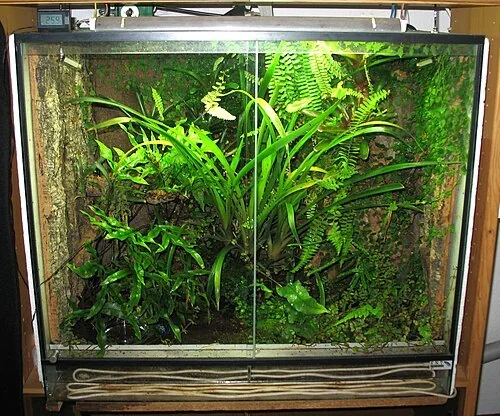
Start from the enclosure, not the bulb aisle. A tall, heavily planted enclosure for a shade dwelling species usually needs only a low output T5 SO or T8 tube spanning most of its length.
A wide, open desert setup usually needs a T5 HO tube in a reflective fixture instead. Mount it close, and leave it uncovered by anything but bare screen.
Bigger baskers in large enclosures are the exception. A fluorescent tube often cannot throw UVB far enough to cover the whole basking branch or rock. That is where a mercury vapor bulb earns its higher cost and shorter working life.
Full setup layout and how UVB pairs with a basking bulb and a thermostat are covered separately at heating and UVB setup design.
Whatever bulb you choose, budget for a UV index meter as part of the setup cost. Do not treat it as an optional extra. It is the only tool that confirms the reptile supplies you bought are doing their job once mesh, distance, and bulb age are all factored in.
Recommended UVB Bulbs and Kits
The right bulb depends on the species basking zone and the fixture already on the enclosure. The picks below cover desert, forest, and crepuscular setups, plus a mercury vapor option for large baskers in tall cages. Match the type and strength to the UVI ranges described above, then confirm with a meter after install.
- Best for desert speciesArcadia ProT5 Kit Desert 12%View on Amazon
- Best for forest speciesArcadia ProT5 Kit Forest 6%View on Amazon
- Best for crepuscular geckosArcadia ShadeDweller ProT5 Kit 7%View on Amazon
- Best for large baskersZoo Med PowerSun UVView on Amazon

Arcadia ProT5 Kit Desert 12%
Best for bearded dragons, uromastyx, desert skinks, and sulcata or desert tortoises
- T5 HO desert strength
- Reflector included
- For open top enclosures
Why we pick it
- Reaches a high basking UVI on an open mesh top without mounting inside the enclosure
- Reflector concentrates output so distance rules stay predictable
Keep in mind
- Mount over open mesh only, never behind glass or plastic, and check UVI at the basking spot with a meter
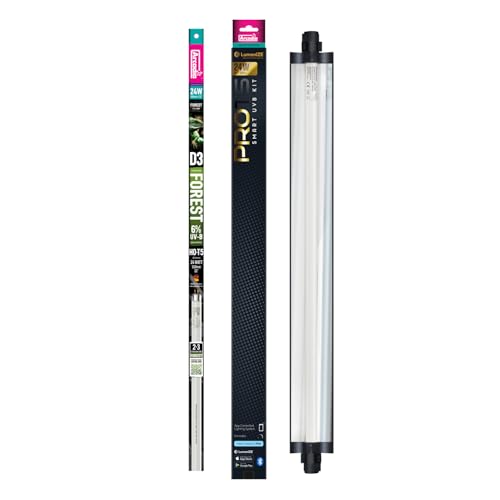
Arcadia ProT5 Kit Forest 6%
Best for crested geckos, gargoyle geckos, chameleons, forest skinks, and some tortoises
- T5 HO forest strength
- Lower output than desert kits
- Reflector included
Why we pick it
- Delivers the lower UVI a shade species needs without a desert strength tube
- Same fixture quality as the desert kit
Keep in mind
- Six percent is not automatically safe at close range for every species, so give the animal room to retreat

Arcadia ShadeDweller ProT5 Kit 7%
Best for leopard geckos and other crepuscular or nocturnal geckos
- Very low usable UVI
- Designed for shade dwelling species
- Reflector included
Why we pick it
- Gives measurable UVB without pushing the UVI past what a crepuscular gecko tolerates
Keep in mind
- Keep the UVI near zero to one and add full enclosure hides so the animal can avoid the light entirely

Zoo Med PowerSun UV
Best for large adult bearded dragons, uromastyx, large monitors, tegus, and iguanas in tall enclosures
- Combines UVB and heat in one bulb
- For tall enclosures needing distance
- Requires a ceramic fixture
Why we pick it
- Covers both basking heat and UVB in a single bulb for cages too tall for T5 tubes to reach
Keep in mind
- Use only in a ceramic or porcelain fixture rated for its wattage, never on a dimmer or timer that cycles power, and check UVI with a meter since output varies bulb to bulb
Whatever kit you choose, run it on a reliable schedule. See our reptile light timer picks for keeping UVB and basking hours consistent.
Frequently Asked Questions
Do all pet reptiles need a UVB light?
Most diurnal, basking species need one, including bearded dragons, uromastyx, many tortoises, and most day geckos. Some nocturnal species, such as leopard geckos and crested geckos, can be kept without one if their diet supplies enough vitamin D3. Many keepers still provide low level UVB anyway as a health benefit.
Is a T5 HO or T8 UVB tube better?
A T5 HO tube produces far more UVB than a T8 tube of the same length and percentage rating. It reaches across a wider area and at a greater distance. T8 tubes remain useful for small enclosures or low UVB species, where a T5 HO would be too strong at any workable distance.
What UVB strength should I buy: 6 percent or 12 percent?
It depends on the species and the distance from the bulb to the basking spot. A 6 percent tube suits shade dwelling or lower light species. A 12 percent tube suits desert baskers in a larger enclosure, where distance and some screen loss cut the dose down.
Is a mercury vapor bulb safe to use?
Mercury vapor bulbs from reputable reptile lighting brands are used safely in zoos and private collections worldwide. The reptile must not be able to reach the bulb, and the basking distance must match the maker’s chart. Cheap, unbranded mercury vapor bulbs have a worse track record for uneven output and early failure.
How often does a UVB bulb actually need replacing?
Most quality T5 HO and T8 tubes need uvb replacement after about 9 to 12 months. They still light up normally well past that point. Coil and compact bulbs often need replacing sooner, closer to 3 to 6 months, and a meter reading is more reliable than the calendar alone.
What does a Solarmeter actually measure?
A Solarmeter reads UV index, a standardized measure of UVB intensity at a given spot. It is the same scale used for outdoor sun exposure. Pointing it at the basking spot tells you the real dose the reptile receives instead of a printed percentage.
Sources
- LafeberVet: UVB Lighting for Reptiles. https://lafeber.com/vet/uvb-lighting-for-reptiles/
- LafeberVet: Sunburned! An Evidence Based Update on UVB Lighting for Captive Exotic Species. https://lafeber.com/vet/sunburned/
- Merck Veterinary Manual: Management and Husbandry of Reptiles. https://www.merckvetmanual.com/exotic-and-laboratory-animals/reptiles/management-and-husbandry-of-reptiles
- Journal of Zoo and Aquarium Research: How much UVB does my reptile need? The UV Tool, a guide to the selection of UV lighting for reptiles and amphibians in captivity. https://jzar.org/jzar/article/view/150