At a glance: A reptile heat lamp is a bulb and fixture pair that creates a hot basking spot, not a substitute for room temperature or the thermal gradient. Halogen and incandescent bulbs add visible light, ceramic heat emitters and deep heat projectors give heat with little or no light, and mercury vapor bulbs combine heat with UVB. Match wattage to enclosure size, run every bulb through a thermostat, such as the Exo Terra Dimming and Pulse Proportional Thermostat, and keep a metal guard on the fixture.
As an Amazon Associate, Lizardist earns from qualifying purchases. Some product links on this page are affiliate links.
A reptile heat lamp is the bulb, dome, and fixture combination that produces a basking spot for an ectothermic pet. It warms one end of the enclosure well above room temperature. The animal can then move into and out of that heat on its own schedule.
The right choice depends on the species basking target and the enclosure size. It also depends on whether the animal needs UVB from the same fixture. This guide compares the common bulb types and walks through wattage and fixture selection.
It also covers the safety habits that keep a heat lamp for reptiles from becoming a burn or fire risk. See building the thermal gradient for how the basking spot fits into the whole enclosure. See UVB lighting for the ultraviolet side of the setup.
What a Reptile Heat Lamp Actually Does
A heat lamp raises the temperature of one localized spot inside the enclosure. That spot is usually a basking branch or flat rock, near one end of the space. It works alongside, not instead of, the broader thermal gradient.
The lamp supplies the hot end. The cool end stays unheated so the animal can thermoregulate by moving between the two. Most heat lamps radiate mainly infrared energy, which reptiles feel as heat but generally cannot see.
Some bulb types also emit visible light, which matters for daytime versus nighttime use. A few combine heat output with ultraviolet B. UVB output and heat output are not the same requirement, and not every basking bulb, such as the Zoo Med Repti Halogen Basking Spot Lamp, provides both.
Bulb Types Compared
Five bulb families cover almost every basking setup. They are standard incandescent, halogen, ceramic heat emitters, deep heat projectors, and mercury vapor bulbs. Each trades off visible light, infrared type, wattage efficiency, and lifespan differently.
| Bulb type | Visible light | Typical use | Day or night | Replacement rule |
|---|---|---|---|---|
| Standard incandescent basking bulb | Bright white or amber | General basking heat, budget option | Day only | When it fails or the basking temperature drops at the same wattage and distance |
| Halogen basking bulb | Bright, slightly whiter than incandescent | Focused, intense basking spot in larger enclosures; use shielded bulbs with a glass front | Day only | Same rule as incandescent; outlasts it in daily use |
| Ceramic heat emitter | None, glows faintly dark red when hot | Ambient or night heat without light; not a sole daytime basking lamp | Day or night | When it fails; no filament to burn out |
| Deep heat projector | Very little, a dim glow | Supplemental or night heat; not a sole daytime basking lamp | Day or night | When it fails; no filament to burn out |
| Mercury vapor bulb | Bright white | Combined heat and UVB in one fixture | Day only | Every 9 to 12 months for UVB output, sooner for cheap imports |
Standard incandescent bulbs are the simplest reptile heat bulb option. They cost the least to replace. They also run less efficiently than halogen for the same basking temperature, and burn out sooner.
A halogen basking bulb produces a tighter, hotter beam per watt.
Choose a shielded bulb with a glass front cover. LafeberVet warns that unshielded halogen capsules can emit UVC and abnormally short wavelength UVB. The glass front blocks both.
That tighter beam suits large baskers such as bearded dragons and larger monitors. These species need a strong hot spot from a fixture mounted well above the animal. Halogen holds up longer than standard incandescent under daily use.
A ceramic heat emitter produces heat with no visible light at all. That makes it useful for raising background or nighttime temperatures in species that should not see light around the clock, such as nocturnal geckos and snakes. Because it throws no light, pair a ceramic heat emitter with a thermostat.
There is no visual cue that it is overheating a hide or branch, so the thermostat, such as the Inkbird ITC-308 Digital Temperature Controller, carries that job instead.
A deep heat projector aims heat downward in a broad spread with almost no visible light. That makes it useful for supplemental warmth or overnight heat on a dimming thermostat. LafeberVet’s guidance is that deep heat projectors and ceramic heat emitters do not emit the wavelengths found in sunlight, so neither should be the sole daytime basking lamp.
The practical pairing is a halogen or incandescent bulb for the daytime basking spot. A deep heat projector or ceramic emitter then covers ambient and night heat.
A mercury vapor bulb outputs UVB, UVA, and heat from a single bulb. That can simplify a fixture setup for species with high UVB and high heat needs.
Bearded dragons, uromastyx, and some monitor lizards fall into that group.
Mercury vapor bulbs run on an internal arc tube and cannot be dimmed or thermostat controlled, per LafeberVet. A switched off arc tube needs a cool down period before it restarts. Basking distance and wattage must therefore be chosen carefully before the fixture goes in.
Clear faced mercury vapor bulbs often throw a narrow, intense beam. LafeberVet also reports extreme variability in UVB output, even between bulbs of the same brand. A UV index meter is the only way to know what a given bulb delivers at a given distance.
UVB output from any bulb, mercury vapor included, drops over the life of the bulb. It falls well before the visible light or heat output changes.
VCA advises replacing UVB bulbs every 9 to 12 months. LafeberVet notes that inexpensive imports may need replacing after 3 to 6 months.
Infrared Types and What They Mean for Basking
Infrared radiation used in reptile heating is grouped into infrared A, infrared B, and infrared C, based on wavelength. Infrared A has the shortest wavelength of the three and penetrates tissue most deeply. Infrared B penetrates less, and infrared C stays at the surface.
Sunlight striking a basking rock delivers a mix that leans toward infrared A and infrared B. Halogen and incandescent bulbs emit infrared A along with visible light, which LafeberVet describes as suitable for a basking zone. That is why they remain the daytime basking choice.
Ceramic heat emitters and deep heat projectors emit longer wavelengths that warm the surface of skin and substrate without reproducing the sunlight spectrum. They are best treated as background and night heat.
Neither type is unsafe when used correctly. The distinction mainly affects how a basking spot feels and how evenly it warms an animal.
Choosing Heat Lamp Wattage for Enclosure Size
Heat lamp wattage has to be matched to enclosure size, fixture height, and the room’s ambient temperature. It cannot be picked from a fixed chart alone. A bulb that hits 95 degrees Fahrenheit in a small, warm room can overshoot 120 degrees Fahrenheit in a cooler room.
The only reliable method is to test the actual basking surface temperature after installing the bulb. Use a probe thermometer or temperature gun, as covered in our guide to reptile temperature and measurement tools. Treat any wattage chart as a starting point, never a final answer.
| Enclosure size (approximate) | Starting wattage to test | Fixture height above basking spot |
|---|---|---|
| Under 20 gallons or a small tub | 25 to 50 watts | 8 to 10 inches |
| 20 to 40 gallons or similar footprint | 50 to 75 watts | 10 to 12 inches |
| 40 to 75 gallons, standard bearded dragon or blue tongue skink setup | 75 to 100 watts | 12 to 16 inches |
| Large custom enclosures, tegus and adult monitors | 100 to 150 watts, sometimes two fixtures | 16 to 24 inches |
These starting points assume a room near 72 to 78 degrees Fahrenheit. A cooler room needs a higher wattage or a closer fixture to hit the same basking number. A warm room needs less of either.
The target itself comes from the species, not the bulb.
The Merck Veterinary Manual’s rule is that the basking surface should run about 5 C (9 F) above the daytime ambient range. Temperatures can then fall about 5 C at night. Species basking numbers are on each care page.
Always start at the low end of a range. Measure the actual surface temperature at the basking spot after an hour. Step up in small increments rather than starting with the largest bulb available.
Raising or lowering the fixture changes the basking temperature as much as swapping wattage does. Species with a lower basking target, many nocturnal geckos among them, often need no daytime basking bulb at all, and rely on ambient heat instead.
Species with a high basking target, including bearded dragons and uromastyx, may need the top of these ranges. Some need a second bulb to reach 100 degrees Fahrenheit or more.
Fixtures, Domes, and Reflectors
A reptile lamp fixture is rated for a maximum wattage. Running a bulb above that rating overheats the socket and the dome’s wiring. That is a fire risk regardless of bulb type.
Ceramic sockets rated for 150 watts or higher handle high wattage basking bulbs and ceramic heat emitters safely.
Cheaper plastic sockets are not rated for the heat a ceramic heat emitter or a halogen bulb produces. They should not be used with either. Always check the fixture’s printed maximum wattage before installing a new bulb type.
A deep dome reflector, rather than a shallow one, concentrates more of the bulb’s output onto the basking spot. It reduces the amount of heat that escapes sideways and warms the room instead of the enclosure. Clamp lamps work for many setups.
A fixture that sits directly on the enclosure’s screen top, rather than clamped to a stand, is the classic way a bulb ends up against something flammable. The screen sags and the hot dome rests on the wooden lid or a plastic rim. Mounting the fixture on an independent stand avoids that failure mode.
Burn and Fire Safety
Any bulb hot enough to warm a basking reptile is also hot enough to burn skin on contact. LafeberVet lists poorly protected heat lamps, malfunctioning hot rocks, and heat tape as the common causes of thermal burns in pets. Reptiles do not reliably move away from a surface that is burning them.
A wire guard between the bulb and the animal is standard practice, not an optional accessory. It also protects the bulb from a curious animal climbing directly onto it. A burn needs a reptile veterinarian, since treatment involves cleaning and debriding the wound and managing pain.
An animal climbing onto a ceramic heat emitter or halogen bulb can crack the glass and expose bare, powered elements. Fire risk comes mainly from three sources. These are a fixture resting on flammable material, a bulb run past its rated wattage, and a cheap socket that arcs or melts under sustained heat.
Keeping the dome a few inches from any wood, foam, or plastic part cuts that risk. So does checking the cord is not pinched under the lid. Replace any fixture with a cracked socket or scorched cord right away.
Unplugging or replacing a heat lamp the moment a thermostat fails to control it matters most of all.
Do not wait to see whether the fixture stabilizes on its own. An uncontrolled bulb is the common thread in overheating and burn cases.
Pairing a Heat Lamp With a Thermostat
Every reptile heat lamp should run through a thermostat rather than directly into a wall outlet. Room temperature swings and seasonal changes will otherwise push the basking spot well outside a safe range without warning. Our guide to reptile thermostats covers the two main types in detail, but the short version matters here too.
A dimming thermostat lowers and raises the bulb’s power smoothly to hold a set temperature. It works with any incandescent, halogen, ceramic heat emitter, or deep heat projector. It cannot be used with a mercury vapor bulb, which LafeberVet says cannot be dimmed or thermostat controlled.
An on and off thermostat instead switches the bulb fully on or fully off around a target temperature. That design suits ceramic emitters and setups where a little temperature cycling is acceptable. It does not suit a mercury vapor bulb either, because the arc tube needs a cool down period before it restarts.
A mercury vapor bulb therefore runs on a timer only. Its wattage and mounting height have to be chosen so the basking surface never overshoots. Check that with a probe thermometer over a full day.
A pulse proportional thermostat is a less common third type, generally reserved for radiant heat panels rather than basking bulbs.
Placement Inside the Enclosure
A heat lamp belongs above a fixed basking perch, branch, or flat rock. Position it near one end of the enclosure, leaving the far end unheated so a real gradient can form. Mount the fixture outside the enclosure, above a screen top.
That keeps condensation and shed skin away from the bulb and socket. It extends fixture life and cuts the odds of an electrical fault from moisture. The basking spot should sit close enough to reach the species target temperature.
It should never sit close enough for the animal’s back to be within a few inches of the bulb. Even a wire guard only reduces, not eliminates, contact heat at very short range. For arboreal species that climb, the highest branch will be the hottest point regardless of where the lamp was aimed.
Bulb Life and Replacement
Incandescent and halogen basking bulbs are replaced when they fail or when they no longer hold the old basking temperature. Runtime drives that, so a bulb on 12 hours a day fails sooner than one on 8. Ceramic heat emitters and deep heat projectors have no filament to burn out and usually outlast several basking bulbs.
Replace a bulb that has visibly dimmed or flickers. Also replace one that no longer holds the old basking temperature at the same wattage and distance, since heat output can fall well before total failure.
Mercury vapor bulbs are the exception on timeline. Their heat output often stays roughly constant even as UVB output declines.
A mercury vapor bulb that still warms the spot correctly still needs replacement every 9 to 12 months, purely for its UVB half of the job. Only a UV index meter reading justifies keeping it longer.
Red and Night Heat Lamps
A red heat lamp for reptiles is an incandescent or halogen bulb with red coated glass. It is sold on the idea that reptiles cannot perceive red light, so it will not disrupt their sleep cycle.
No veterinary source reviewed for this guide supports that claim. VCA stresses a consistent day and night cycle for normal feeding and immune function.
Reptile color vision varies by species, and a red bulb is still a visible light source. The safe assumption is that the animal can see it. A ceramic heat emitter or a deep heat projector run overnight avoids the light question entirely.
Neither produces light a reptile could perceive. Either can run continuously through a thermostat without disturbing a normal day and night cycle. For a cold room that needs overnight heat only, a ceramic heat emitter set a few degrees below the daytime target is the more conservative choice over a colored bulb.
Recommended Reptile Heat Lamps
The bulb types and wattage rules above point to specific products once you are ready to buy. The lamps below cover the halogen basking bulbs, deep heat projectors, and ceramic heat emitters this page recommends, each paired with the thermostat type it needs. Pick based on your species and whether you need daytime basking heat, deep penetrating heat, or heat without light at night.
- Best overall baskingArcadia Halogen Basking LampView on Amazon
- Best deep heatArcadia Deep Heat ProjectorView on Amazon
- Best nighttime heatZoo Med Repti Infrared Ceramic Heat EmitterView on Amazon
- Best for large lizardsLUCKY HERP 100W Ceramic Heat EmitterView on Amazon

Arcadia Halogen Basking Lamp
Best for arid and high heat species like bearded dragons, uromastyx, monitors, and tegus.
- PAR halogen bulb
- Needs a dimming thermostat
- Costs more than a generic incandescent flood
Why we pick it
- Pushes more usable heat into the basking spot than a standard incandescent bulb
- Sized in wattages that suit the enclosure size rules above
Keep in mind
- Priced well above a generic flood bulb, so budget for it

Arcadia Deep Heat Projector
Best for species that need deep penetrating daytime heat without excess visible light.
- Produces some visible light, similar to a halogen bulb
- Runs on a dimming thermostat
- Best set up with a temperature probe or IR gun
Why we pick it
- Emits mostly the near infrared wavelengths the infrared section above describes as penetrating deepest
- Suited to bearded dragons, uromastyx, monitors, and tegus
Keep in mind
- Verify basking surface temperature with a probe before trusting it
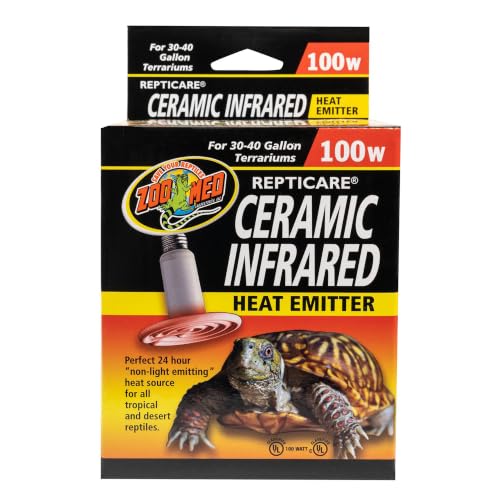
Zoo Med Repti Infrared Ceramic Heat Emitter
Best for adding heat after dark without disturbing a lizard’s day and night cycle.
- Produces no visible light
- Sold across a wattage range for small to large lizards
- Needs a ceramic rated fixture
Why we pick it
- Keeps nighttime temperatures up without the light a daytime basking bulb puts out
- Works across gecko to large monitor setups depending on the wattage chosen
Keep in mind
- Use only in a ceramic rated fixture, never a plastic socket dome built for light bulbs

LUCKY HERP 100W Ceramic Heat Emitter
Best for monitors, tegus, and iguanas that need high output ambient heat.
- 100 watt output
- No visible light produced
- Needs a ceramic rated fixture and thermostat
Why we pick it
- The higher wattage covers ambient heat needs that smaller emitters cannot reach
- Works well as nighttime or supplemental daytime heat in larger enclosures
Keep in mind
- Pair it with a thermostat from day one so the fixture cannot run unchecked
For more ceramic heat emitter options across wattages, see our guide to the best ceramic heat emitters.
Frequently Asked Questions
Can I leave a reptile heat lamp on all the time?
Daytime basking bulbs that emit visible light should go on a timer matched to the species day length. The Merck Veterinary Manual gives 12 hours a day as a suitable general maintenance photoperiod. A ceramic heat emitter, which emits no light, can run around the clock on a thermostat when the species needs overnight heat.
Do LED bulbs work as a reptile heat lamp?
Standard LED bulbs run cool and are not built to produce meaningful basking heat. They do not substitute for a halogen, incandescent, ceramic, or deep heat projector bulb. LED strips add daytime lighting beside a separate heat bulb, not in place of one.
Why is my basking spot too hot even at a low wattage?
A fixture mounted too close to the basking surface, a deep dome reflector, or a warm room combining with the bulb’s output are the three most common causes. Lower the fixture height and remeasure the surface temperature with a probe rather than guessing from air temperature alone.
Can I use a ceramic heat emitter in a halogen fixture?
Only if the fixture’s socket is ceramic and rated for the emitter’s wattage. Plastic sockets can melt or arc under sustained output, so check the fixture’s maximum wattage and socket material first.
Does a mercury vapor bulb need a separate UVB bulb too?
No, a mercury vapor bulb supplies both heat and UVB from the same bulb. A second UVB source is unnecessary and can push total exposure too high. Since UVB output varies widely between individual bulbs, confirm the dose at the basking spot with a UV index meter.
How do I know if my heat lamp wattage is too high for my thermostat?
Every thermostat is rated for a maximum wattage load, usually printed on the unit or its manual. Exceeding it overheats the thermostat even if the bulb and fixture are fine. Add up the wattage on a single thermostat channel and keep the total under its rated maximum.
Sources
- Merck Veterinary Manual: Management and Husbandry of Reptiles. https://www.merckvetmanual.com/exotic-and-laboratory-animals/reptiles/management-and-husbandry-of-reptiles
- VCA Animal Hospitals: Reptiles, Proper Lighting. https://vcahospitals.com/know-your-pet/reptiles—proper-lighting
- LafeberVet (Baines, F.): UVB Lighting for Reptiles. https://lafeber.com/vet/uvb-lighting-for-reptiles/
- LafeberVet: Presenting Problem, Burns in Snakes and Lizards. https://lafeber.com/vet/presenting-problem-burns-in-snakes-and-lizards/